










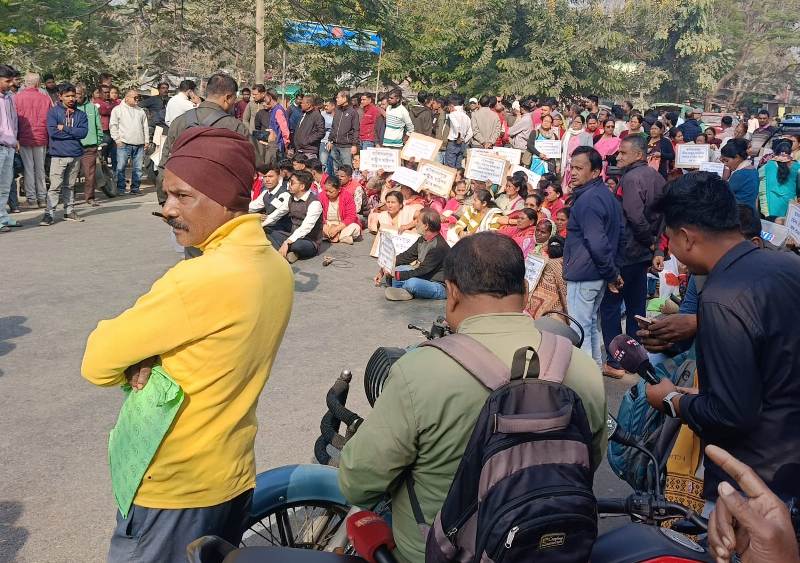
Nagaon: The entire stretch of road between Kaliabor and Jakhalabandha in central Assam was blocked on Thursday as residents protested against the proposed diversion in the four-laning project of the Kaliabor–Numaligarh section of National Highway (NH) 715, severely disrupting road connectivity to Upper Assam and several other Northeastern states.
Protesters also staged a demonstration outside the Circle Officer’s office, bringing normal movement in the area to a standstill.
The agitation is directed against the alignment of the highway, which, according to protesters, will divert traffic from Kaliabor Tiniali, bypassing Kuwaritol, Hatbor and Jakhalabandha, and adversely affect more than 80,000 residents in the region.
The Union Cabinet in October approved the four-laning of the 86-km Kaliabor–Numaligarh stretch of NH-715 at an estimated cost of Rs 6,957 crore. The project includes a 34-km elevated viaduct passing through Kaziranga National Park as part of efforts to ensure wildlife-friendly infrastructure.
ALSO READ: APCC chief Gaurav Gogoi condemns vandalism of Christmas decorations at Nalbari school
Earlier, the Kaliabor Four Lane Demand Committee had submitted a formal representation to Union Minister for Road Transport and Highways Nitin Gadkari, urging him to halt the proposed diversion and instead upgrade and widen the existing highway.

The representation was supported by a public survey, which, the committee claimed, showed overwhelming opposition to the diversion from local residents and business owners.
The Kaliabor Four Lane Demand Committee had already moved the Gauhati High Court against the project.
Senior advocate K.N. Choudhury argued that the biggest landholder and primary beneficiary of the diversion is Pride East Entertainment Pvt. Ltd., which owns over 100 bighas along the proposed route.
The diversion, which would require constructing over 14 km of new roadway, poses severe economic and ecological threats. The cost of land acquisition, earth-filling, and bridge construction would be significantly higher compared to upgrading the existing road, which already spans 60 meters in width in many places.
Besides, the new route would cut through eco-sensitive water bodies and an elephant corridor, increasing risks of man-elephant conflicts and damaging wetland ecosystems.