










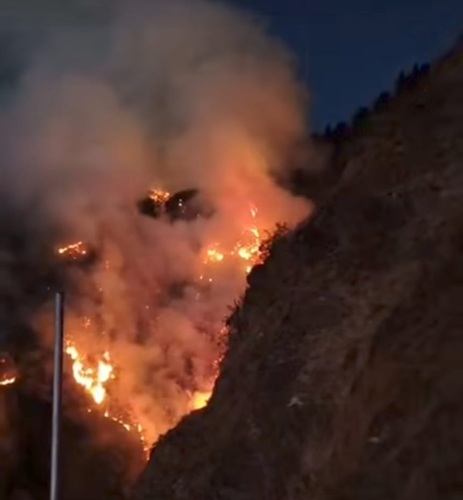
Guwahati: The Indian Army and the Indian Air Force are engaged in large-scale joint operations to control massive forest fires raging across parts of Arunachal Pradesh and Nagaland, with aerial and ground-based missions continuing under extremely challenging conditions.
IAF helicopters have been carrying out sustained water-dropping operations in difficult terrain, while Army units and ground teams are deploying specialised firefighting equipment and manpower to contain the spread of flames.
In a statement shared on X, the Indian Air Force said its helicopters were battling wildfires on two fronts, confirming that nearly 1.4 lakh litres of water had been dropped in the Walong sector of Arunachal Pradesh, leading to the successful dousing of major fire zones.
Simultaneously, aerial firefighting operations are continuing over the Dzukou Valley in Nagaland, where Mi-17 V5 helicopters are drawing water from Padumpokhiri Lake in Dimapur to tackle fires near Japfu Peak.
Officials said the operations are being carried out amid steep slopes, poor visibility and thin air, making aerial precision drops critical for containment.
In Arunachal Pradesh, Army troops, supported by IAF helicopters, have been battling a major blaze in Walong, a remote high-altitude area in Anjaw district, where the fire reportedly broke out on February 13.

The region’s difficult terrain, combined with limited ground access, has made aerial operations a key component of the response strategy.
Visuals released by the Army showed helicopters conducting repeated water drops over burning hillsides, while ground teams worked to secure vulnerable zones and prevent fresh flare-ups.
Earlier operations in the Lohit Valley region also saw IAF helicopters flying multiple sorties above high-altitude ridgelines, delivering thousands of litres of water to strike active fire hotspots, despite inclement weather and reduced visibility.
ALSO READ: Meghalaya Assembly sees uproar over ILP, House adjourned briefly
According to defence officials in Guwahati, prolonged dry weather and traditional jhum (slash-and-burn) cultivation practices are among the major factors contributing to forest fires in the Northeast.
Over the past several days, coordinated round-the-clock operations have involved heavy machinery, specialised equipment, aerial reconnaissance and continuous helicopter support to bring the situation under control.
Officials said the combined efforts of the Army and IAF have played a decisive role in preventing the fires from spreading further, especially in steep and remote forested areas where ground intervention alone is not possible.
With dry conditions persisting, authorities remain on high alert, maintaining close coordination between aerial units and ground teams to contain any new outbreaks and protect ecologically sensitive forest regions.