










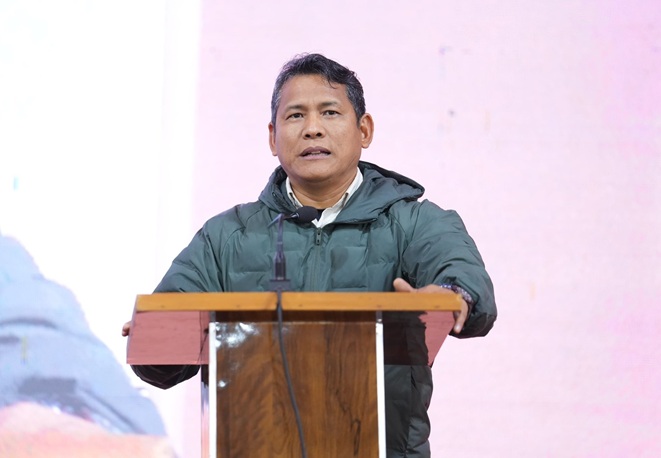
Itanagar: Ojing Tasing, Rural Development and Panchayati Raj Minister of Arunachal Pradesh, said the state government is planning to introduce a digital governance system that will disseminate information about government schemes in tribal languages to help people in remote villages better understand welfare programmes.
Speaking about the initiative, the minister said the proposed system will include a local language interface and digital screens installed in villages to improve awareness and strengthen grassroots administration.
Panchayat leaders will also be trained to operate the system and share information with villagers.
Tasing noted that language barriers often make it difficult for people in rural areas to fully understand government initiatives, as many residents are not comfortable with English or Hindi.
Arunachal Pradesh is home to 26 major tribes, and the government is exploring ways to convert official information into formats that can be easily understood at the community level.
The proposal has already been discussed with Chief Minister Pema Khandu and may be introduced initially as a pilot project covering two or three tribes before being expanded across the state.

According to the minister, the system may use the Roman script to represent tribal languages because several indigenous languages in the state do not have standard written scripts.
If approved, television-like digital screens will be installed in villages to display information on government schemes and administrative updates.
Alongside the language-based dissemination system, the government is also developing an online platform aimed at strengthening transparency and monitoring administrative functioning at the grassroots level.
The portal will provide details of government employees posted in districts, including their transfers, contractual appointments and photographs, enabling better oversight of administrative processes.
Tasing said the digital monitoring system is nearly ready and will be launched soon.
The initiative is expected to help authorities track the implementation of schemes more effectively and enhance accountability.
He added that the government is continuing its efforts to strengthen decentralised governance by empowering panchayats, although certain structural challenges remain.
While financial and administrative powers have been devolved to local bodies, practical implementation sometimes faces hurdles due to procedural gaps and local administrative practices.
The minister also highlighted difficulties in implementing online auditing systems in remote areas because of poor internet connectivity and lack of road infrastructure. Several villages in the state still remain difficult to access, making it challenging to expand telecommunications networks.
Referring to his own constituency, Tasing said some villages were previously cut off from connectivity, but infrastructure projects sanctioned under schemes such as the Rural Infrastructure Development Fund are gradually improving road and communication access.
ALSO READ: Manipur: Four held for extorting contractual nurses, Rs 39 lakh seized
He also revealed that the government had earlier proposed making a minimum educational qualification mandatory for panchayat representatives, but the idea did not receive adequate support, a report stated.
According to the minister, better awareness and capacity among local leaders are essential for effective implementation of government programmes.
Panchayat representatives often need to interpret guidelines and explain schemes to villagers, making education an important factor in local governance.
Tasing said the government is now focusing on educating rural communities about the broader benefits of development schemes, as many people still associate such programmes only with direct financial assistance.
He added that the department, despite limited manpower, is continuing efforts to strengthen grassroots governance and increase awareness so that villagers can participate more actively in development initiatives.