










By Enayet Kabir
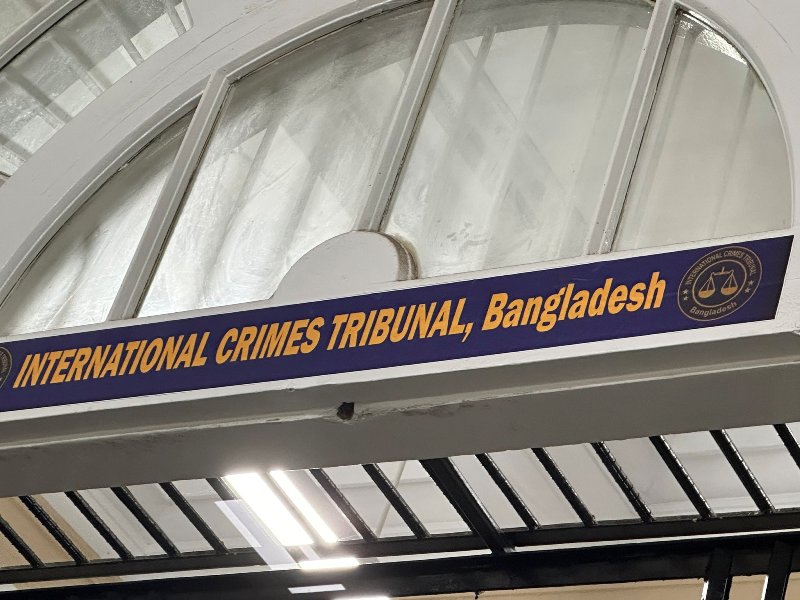
The judicial proceedings are continuing at the International Crimes Tribunal (ICT)—established for the trial of war criminals—without resolving the debate over whether the “July incident” can legally be tried in this court.
However, new Chief Prosecutor Aminul Islam told the media that during the rule of Muhammad Yunus’s interim government, the case files and verdict documents of the three judgments— including death sentences—issued against the ousted Prime Minister Sheikh Hasina by the International Crimes Tribunal will be re-examined.
The investigations will determine whether there were major lapses, negligence, or errors in the investigation of these cases and whether there were irregularities or inconsistencies in the verdicts. If any such issues are found, legal action will be taken.
Additionally, the tribunal is examining whether the murders and killings associated with the “July incident” can be tried in this tribunal and whether there are any legal flaws in doing so.
It is worth noting that after Bangladesh’s Liberation War in 1971, the International Crimes Tribunal was established in 1973 during the government of Bangabandhu Sheikh Mujibur Rahman. Its purpose was to prosecute war crimes committed by the Pakistani army and their local collaborators—razakar, Al-Badr and Al-Shams.

However, after the political change following the August 15, 1975, events, the judicial process came to a halt. Later, after winning the 2008 elections, the Awami League government reconstituted the tribunal to prosecute war crimes.
One of the key promises of the Grand Alliance government led by the Awami League, which won the 2008 national parliamentary election, was to conduct war crimes trials. In 2009, the Awami League amended the 1973 law, and the first tribunal was formed on March 25, 2010. As the number of cases increased, another tribunal was formed on March 12, 2012.
On January 21, 2013, the first verdict sentenced Abul Kalam Azad (also known as Bachchu Razakar)—a notorious razakar from Faridpur—to death. Several leaders of Jamaat-e-Islami and the BNP were also convicted by this tribunal. In total, during the Awami League government, two tribunals delivered verdicts in 66 cases.
Currently, however, the two tribunals are conducting trials in 21 cases related to murder, torture, and other crimes associated with the July 2024 incident. Under the initiative of the new Chief Prosecutor, major changes are expected in the tribunal soon. According to multiple sources, several controversial prosecutors may resign or be removed within this month.
There are also allegations against the outgoing Chief Prosecutor, Mohammad Tajul Islam, and several other prosecutors regarding professional misconduct, breach of discipline, and unethical activities. A special team may be formed to investigate these allegations.
Significant changes are also expected soon in the prosecution and investigation agencies of the ICT. The new government led by the BNP has taken various preliminary initiatives to make the trial process of the July crimes against humanity more dynamic and transparent. These include restructuring the prosecution department and the investigation agency.
Senior lawyers of the Supreme Court believe that in the interest of justice, the Chief Prosecutor has the authority to review investigations and verdicts if necessary. Several lawyers also said that the prosecution may analyse the cases to determine whether appeals were properly filed.
Multiple sources within the tribunal’s prosecution department say that most of the 21 ongoing cases were filed based on verbal instructions from the interim government. It is alleged that decisions about who would be made an accused in these cases were sometimes taken while sitting in an office room of a private university. The new prosecution intends to investigate these allegations seriously.
At the same time, the new prosecution will review the acceptability and legal validity of four ordinances issued by the interim government concerning the tribunal— including provisions for banning political parties and trying military personnel.
Some believe that if investigations are conducted properly, many previously unknown and serious allegations may emerge.
After the political change on August 5, 2024, a new dimension was added to the ICT. Overnight, defence lawyers became state prosecutors.
The interim government appointed Tajul Islam, a Jamaat-leaning Supreme Court lawyer, as Chief Prosecutor, even though he had previously been a defence lawyer for those accused of crimes against humanity during the Awami League government. At the same time, the ICT was reinstated.
Currently, 457 people are on trial in 21 ICT cases. Among them, 283 are fugitives and 164 are in prison. Initially, trials began in one tribunal, but another tribunal was formed last year. As of February 9 this year, formal charges have been filed in 24 cases in the two tribunals. Verdicts have already been delivered in three cases.
In one of those cases, the ousted Prime Minister Sheikh Hasina and her government’s Home Minister Asaduzzaman Khan Kamal were sentenced to death. Additionally, 11 people, including former Dhaka Metropolitan Police Commissioner Habibur Rahman Habib, received prison sentences of varying lengths. One accused who became a state witness was acquitted.
The verdict in the case of the Abu Sayeed killing in Rangpur will be announced on April 9. Meanwhile, 34 more cases related to the July crimes against humanity are still under investigation.
Furthermore, former military officer, Maj Gen Ziaul Ahsan is facing trial for enforced disappearances, killings, kidnappings, and torture during the Awami League government.
Twenty military officers—both former and current—are also accused. In addition, 65 police officials, including senior officers, are defendants in cases related to the July crimes against humanity.
During the previous interim government, the prosecution was largely controlled by Jamaat-leaning lawyers under Chief Prosecutor Tajul Islam. With the change of government, that leadership also changed. On February 23, the BNP government canceled the appointment of the powerful Chief Prosecutor and appointed Supreme Court lawyer Aminul Islam as the new Chief Prosecutor.
The question now is whether the ICT has become free of controversy after Tajul Islam’s removal. Since the day of his departure, various allegations of unethical activities and irregularities have surfaced, including serious accusations such as leaking information from the prosecution. These issues have created instability and frustration within the prosecution.
Regarding these matters, the new Chief Prosecutor Aminul Islam said that the tribunal will soon take decisions in a proper, orderly and legally sound manner.
In this context, Supreme Court senior lawyer Barrister Sara Hossain told the media that many people had been detained without trial for 17 months in the name of justice. She expressed hope that the change of the Chief Prosecutor would bring an end to acts of revenge.
Finally, the legal question of whether the “July incident” can legitimately be tried in a court established to prosecute war crimes must be resolved first.
(The writer is a political and economic analyst)