









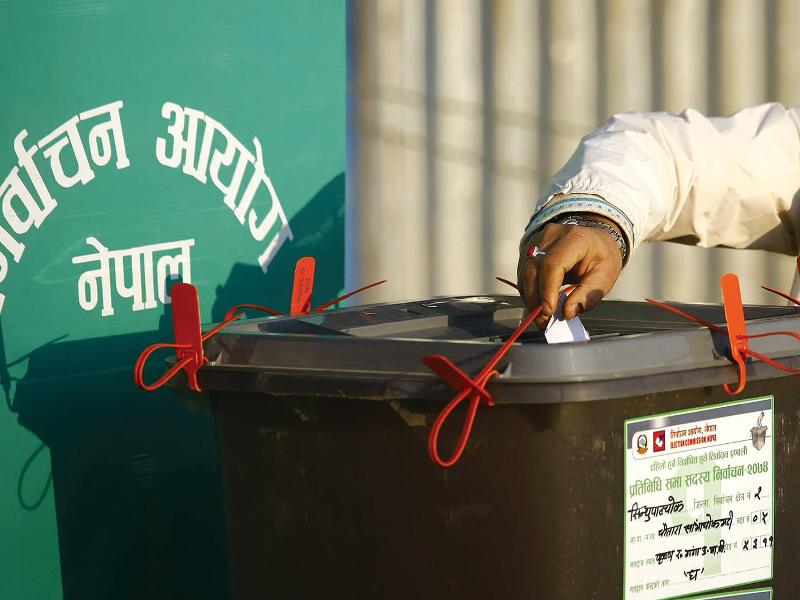
Nepal will head to the polls on Thursday (March 5) in a high-stakes general election widely viewed as a turning point in the country’s political landscape.
More than 1.89 crore registered voters are eligible to elect a new 275-member House of Representatives, with polling scheduled from 7 am to 5 pm across the country.
A total of 3,424 candidates are contesting under the first-past-the-post (FPTP) system, while 3,213 candidates are in the fray under the proportional representation (PR) system. Of the 275 seats, 165 lawmakers will be elected directly through FPTP, and 110 seats will be filled under PR, in line with constitutional provisions.
The elections were originally scheduled for November–December 2027 but were advanced by nearly two years following the Gen Z-led uprising of September 8–9. The protests, initially triggered by a social media ban, soon escalated into a nationwide movement against a stagnant economy and alleged corruption among the governing elite.
The unrest ultimately forced Prime Minister KP Sharma Oli to resign, bringing down the coalition government backed by the Nepali Congress and the Communist Party of Nepal (Unified Marxist–Leninist).
This election is being shaped less by traditional party rivalries and more by the aftereffects of the youth-led movement that challenged Nepal’s established political order.

Generation Z voters are expected to play a decisive role, driven largely by frustration over unemployment, corruption and the dominance of traditional political elites.
Having spearheaded last year’s protests, many young voters are now approaching the ballot with a demand for accountability and systemic reform rather than loyalty to established parties.
Political observers have noted a surge in enthusiasm among young voters. Political scientist Krishna Pokharel told The Kathmandu Post that a significant number of young Nepalis have returned from abroad specifically to participate in the polls.
According to Nepal’s Department of Immigration, returnees increased by 28.58 percent in the lead-up to the election, with 148,623 Nepalis flying back home in February compared to 115,584 during the same period last year.
Young voters are also seen as more inclined toward performance-based voting, assessing candidates on commitments related to job creation, transparency, digital freedom and governance reforms.
At the centre of this generational shift stands Balendra Shah, popularly known as Balen, a 35-year-old former rapper who rose to prominence with songs criticising the political elite before winning a landslide victory as Kathmandu’s mayor in May 2022.
Now associated with the Rastriya Swatantra Party, Shah is contesting against Oli and has emerged as a frontrunner for prime minister.
While traditional parties have dismissed new entrants as lacking ideological depth, Shah remains a popular figure among younger voters. Although Gen Z leaders had favoured him to lead the interim government after the protests, he declined at the time, choosing instead to seek a mandate through the ballot box.
Despite the prominent role played by Nepali women in last year’s anti-corruption protests, their representation among candidates remains limited.
Women account for only about 10 percent of the more than 3,400 candidates contesting under the direct voting system, even though the constitution mandates that at least one-third of parliamentary seats be held by women.
As part of election preparations, the Election Commission of Nepal enforced a mandatory silence period from midnight on March 2, barring parties and candidates from canvassing or organising public events until voting concludes. A nationwide ban on the sale and consumption of alcohol has also been imposed until final results are declared.
Security has been significantly tightened ahead of polling day. The India–Nepal international border has been sealed until March 5, with only ambulances and emergency services allowed to cross, and joint patrols along with CCTV surveillance are being conducted in border areas.
The Nepal Army has implemented a three-phase security plan covering the pre-election, polling and post-election periods. Army spokesperson Rajaram Basnet said the force will guard polling stations and counting centres, conduct aerial patrols and dispose of suspicious objects.
A three-tier security arrangement will be deployed at all voting centres, and integrated security teams will escort ballot boxes to counting sites after polling concludes.
In total, around 3,30,000 security personnel, including 80,000 Nepal Army soldiers, along with members of Nepal Police and the Armed Police Force, will be mobilised to ensure the elections are conducted in a free, fair and secure manner.
ALSO READ: Youth push for good governance drives Rastriya Swatantra Party’s surge ahead of Nepal elections
With a large section of first-time voters set to participate, Gen Z’s turnout and electoral choices are expected to significantly shape voting patterns and potentially determine the outcome of one of Nepal’s most closely watched elections in recent years.