










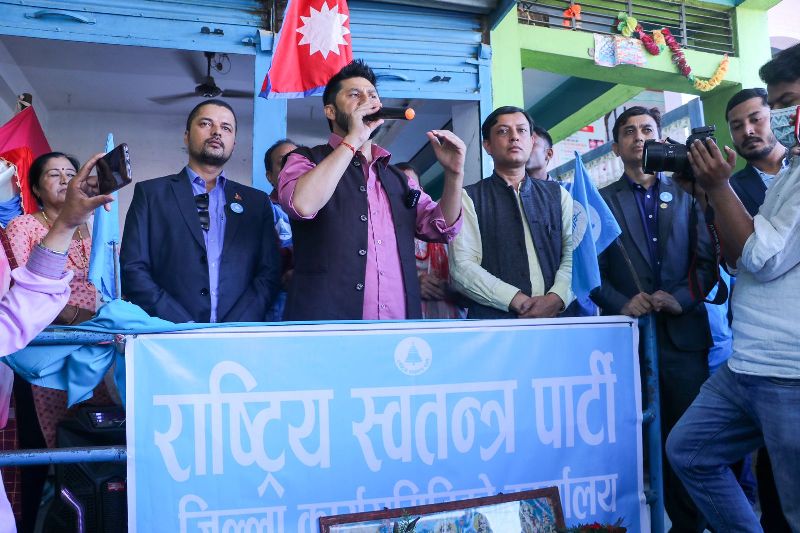
Nepal is heading into a crucial election on March 5 amid visible shifts in voter sentiment, particularly among young people who are increasingly demanding change, accountability and development-driven politics.
At the centre of this shift is the rising influence of the Rastriya Swatantra Party (RSP), which appears to be gaining ground as one of the most prominent parties in Nepal’s new political landscape at the expense of traditional forces such as the Nepali Congress and the Communist Party of Nepal (Unified Marxist–Leninist) and Nepal Communist Party.
Formed in July 2022 by former television presenter Rabi Lamichhane, the RSP stunned many in the last election by winning 21 seats in the House of Representatives. Though internal challenges and legal controversies affected the party’s early momentum, last year’s Gen Z-led political wave has revived its prospects.
This is mainly due to the popularity of its prime ministerial candidate, Balen Shah, who joined the RSP in January as a senior leader and is the most trusted person by Gen Z leaders.
Political observers say the party’s image as an alternative to the old political system, along with its strong focus on better governance, is connecting well with urban voters and those voting for the first time.
The RSP recently presented its 100-point commitment plan or poll manifesto at a public gathering in Surkhet, Karnali province.

The RSP’s platform centres on structural political reform, including initiating a constitutional amendment process through national consensus. The party advocates a directly elected executive leadership model, a fully proportional parliamentary system and non-partisan local governments.
On economic and regional cooperation, the RSP proposed expanding energy diplomacy through short, medium and long-term electricity trade agreements with neighbouring countries such as India and Bangladesh. It also called for balanced and adaptive foreign policy measures to convert shifting geopolitical dynamics into development opportunities.
Infrastructure proposals in the RSP manifesto include construction of an east–west electric railway to facilitate passenger and cargo movement, as well as rail connectivity linking Kathmandu and major southern cities with Indian and Chinese networks.
The party further pledged to digitalise public service delivery and reform the bureaucracy to ensure professionalism, neutrality and accountability, alongside promoting a digital economy to spur growth and employment.
The party’s growing appeal comes as established forces like the Nepali Congress (NC) and the Communist Party of Nepal (Unified Marxist–Leninist) (CPN-UML), led by former prime minister KP Sharma Oli, face mounting public scrutiny.
While the Nepali Congress continues to enjoy a loyal base and organisational strength, it is facing tough competition in constituencies where younger voters are seeking alternatives to legacy politics.
A major reason behind the current election mood is public anger against former Prime Minister K. P. Sharma Oli. This anger had sparked a strong Gen Z-driven movement, led to the formation of the interim government, and is influencing the upcoming elections.
Although the party was popular before the 2022 election, there is increasing frustration with it now, especially among the youth vote.
Despite Oli’s downfall after the September protests, he was re-elected for a third term as head of the party last December. Critics accuse him of political instability, governance lapses and prioritising power struggles over pressing economic concerns.
Among sections of the youth, there is visible frustration with what they see as repetitive coalition politics and a lack of tangible progress.
For many young voters, the election is less about ideology and more about results. Youth enthusiasm for change is visible at campaign rallies and across social media platforms, where conversations centre on employment opportunities, corruption-free governance, economic growth and efficient public services.
While traditional parties are trying to reconnect with younger voters through promises of reform, the RSP’s messaging on systemic overhaul appears to have struck a chord, especially among young voters.
Meanwhile, the CPN-UML released its manifesto in Kathmandu, outlining what it described as a development-oriented and stability-focused agenda. In its document, the CPN-UML placed strong emphasis on good governance, infrastructure expansion, job creation and social equity.
Earlier, the Nepali Congress, Nepal’s largest democratic party, also released its election manifesto under the slogan “Sustainable Infrastructure, Strong Economy, Secure Future, Developed Nepal.” Party president and prime ministerial candidate Gagan Thapa outlined commitments focused on economic expansion, improved living standards, urban development, energy generation and enhanced national connectivity.
ALSO READ: Campaigning ends in Nepal as silence period begins ahead of March 5 polls
As polling approaches, the central question remains whether youth-driven momentum will translate into seats for emerging players like the RSP, or whether established parties will retain their dominance.
The election will see 3,424 candidates contesting under the first-past-the-post (FPTP) system, while another 3,213 candidates are vying for seats under the proportional representation system.