










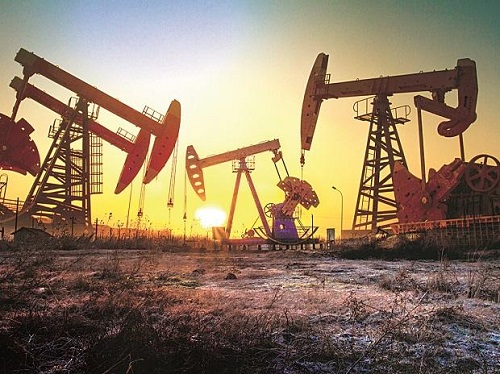
Oil prices jumped sharply on Monday as the rising conflict in West Asia sparked fears of disruptions to global supply.
The surge followed retaliatory Iranian attacks that disrupted shipping in the strategic Strait of Hormuz, following the weekend strikes by Israel and the United States that killed Iranian Supreme Leader Ali Khamenei.
A prolonged increase in crude prices could pose challenges to global economic recovery, spur inflation, and could push up U.S. retail gasoline prices, a politically sensitive issue ahead of the November midterm elections.
When trading resumed on Monday, the price surge, however, fell short of some analysts’ earlier predictions. Brent crude futures touched an intraday high of $82.37 per barrel, their highest since January 2025, before settling at $78.87, up $6.00 or 8.2% by 0919 GMT. Meanwhile, U.S. West Texas Intermediate (WTI) crude spiked to $75.33, its strongest level since June, before paring gains to $72.17, up $5.15 or 7.7%.
Also Read: Middle east crisis: No immediate oil supply disruption for India, but price volatility looms
On Sunday, some analysts had predicted oil would open on Monday at over $90 a barrel and closer to $100.

The sharp price movement was triggered as counterattacks in the Gulf region damaged several tankers and disrupted shipping along the Strait of Hormuz, a critical route connecting the Gulf to the Arabian Sea.
According to shipping data, over 200 vessels, including oil and liquefied gas tankers, anchored outside the strait. The attacks also resulted in damage to three tankers and the death of one seafarer.
In a parallel development, eight OPEC+ members – Saudi Arabia, Russia, Iraq, the UAE, Kuwait, Kazakhstan, Algeria and Oman agreed on Sunday to increase oil output by 206,000 barrels per day, a move seen as an attempt to stabilise markets amid volatility.