










By Enayet Kabir
Discussion has become significant in Bangladesh regarding the alleged instigation by the United States and involvement of the United Nations in the state takeovers by “non-political” groups in 2024 and 2007.
The reason is that on neither occasion was a short-term caretaker government formed on the basis of a “political agreement” among political parties for overseeing elections or handling an emergency.
Rather, with military backing, non-political groups seized control of the state for an “indefinite period” in pursuit of group interests. To understand the difference between a “change of rulers” through constitutional voting and a “state capture” by mafia groups under foreign instigation, is the “Bangladesh study” of the past 20 months not sufficient?
It goes without saying that there was justified public anger in the country against Sheikh Hasina’s Awami League government. But using that as a pretext for a US-planned “regime change” does not absolve the Bangladeshi actors involved from accusations of treason.
In countries where regime change occurred through colour revolutions, there was always some public dissatisfaction with the government; the “popular explosion” emerged around that anger.

By spreading propaganda accusing Sheikh Hasina of genocide around the innocent quota reform movement, a planned “regime change” was carried out in Bangladesh. If this had been a mass uprising led by organised political groups aiming at “government change,” then the unconstitutional, occupying “razakar military-NGO” government would certainly not have been prolonged for 18 months.
Rather, the anti-Awami political parties, under BNP leadership, would have forced elections within 90 days in accordance with the Constitution.
The difference between “change of rulers” and “state capture” is vast. On August 5, 2024, through global and internal conspiracies, the “Bangladeshi state” was captured—this is now the belief of a large portion of the public.
During the constitutional deadlock, President Mohammad Shahabuddin, Army Chief General Waker-uz-Zaman, and the leadership of established political parties failed to fulfill their proper responsibilities.
All became involved in unconstitutional and anti-state roles driven by power and personal interests. In particular, Gen Waker-uz-Zaman and President Shahabuddin may be accused of unconstitutional and ultra vires actions. They knowingly handed over the state unconstitutionally to “US proxies” Muhammad Yunus and Ali Riaz and their associates.
In 18 months, Muhammad Yunus’s “US proxy” government issued 133 unconstitutional ordinances. Amendments to the law of the International Crimes Tribunal, and ordinances regarding general elections and referendums, were issued without even informing the president.
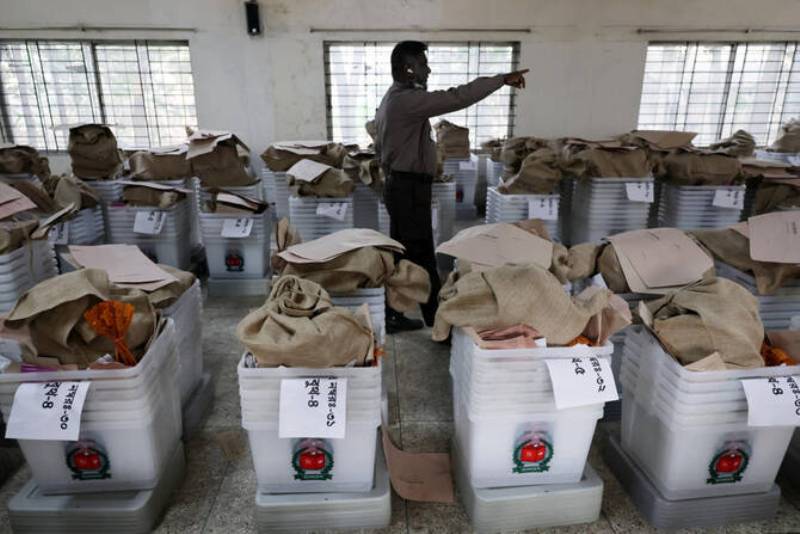
Under those unconstitutional ordinances, the general election and referendum held on February 12, 2026, were allegedly rigged—something even the Election Commission has admitted and demonstrated.
The difference between the 2008 election and the 2026 election is significant. In 2008, the actors were compelled to transfer power after holding an “inclusive” and credible election.
Reasonable time was taken to prepare the NID (voter ID) system, and they earned praise for conducting elections under it.
They did not undertake controversial global agreements. Yet this time, 14 days after the election, the Election Commission stated that 1,074,000 fewer votes had been cast than originally published in the gazette.
The number of “yes” and “no” votes also changed. In centres where referendum numbers changed, did the general election votes not also change accordingly? Those who cast yes/no votes must also have voted for some candidate.
If yes/no votes increase or decrease, candidate votes should differ as well. The Election Commission has provided no information on this. Nor have they explained why 1,074,000 votes decreased.
The second gazette notification regarding the referendum has made the election even more questionable. The day after the election, it was learned that in some centres, more yes/no votes were cast than registered voters. If the Commission stuffed ballot boxes, the numbers for general elections and referendums at each centre would not match. There is nothing surprising about that.
With military backing, Muhammad Yunus’s occupying government signed several global agreements contrary to Bangladesh’s interests. Among them, the most self-destructive is the Reciprocal Trade Agreement (RTA) with the US. One of the key architects of this agreement, then National Security Adviser Khalilur Rahman, has now been made Foreign Minister by the BNP government.
After this elevation, he rushed to the OIC meeting in Saudi Arabia. There he met Pakistan’s Deputy Prime Minister and Foreign Minister Ishaq Dar. Dar informed Khalil that Pakistan’s Prime Minister Shehbaz Sharif wishes to visit Dhaka to meet Bangladesh’s Prime Minister Tarique Rahman. Tarique Rahman has also been invited to Pakistan’s Republic Day parade.
Pakistan wants, at any cost, a high-level representation from Bangladesh at its Republic Day ceremony. Meanwhile, Myanmar’s Foreign Minister Than Swe and, for the first time, the Chairman of the United League of Arakan (ULA) and head of the Arakan Army, Twan Mrat Naing, have congratulated Bangladesh’s new Khalilur Rahman.
It is also true that if freedom of speech is ensured, and “normal” elections are regularly held in a democratic political system—allowing public grievances to be expressed and alleviated through voting or protest—then global powers or the military cannot mislead people.
There was public anger against Sheikh Hasina’s Awami League government over allegations of corruption and vote-rigging, but there was no open path to express or resolve that anger. The accumulated frustration of people unable to vent their grievances was building up. Had there been avenues to address that anger, a colour revolution would not have been possible.
Is Tarique Rahman’s political government capable of exemplary trials of those who captured the state? Is it interested in investigating the main actors behind the allegedly fraudulent seizure of the state? Over the past 18 months, the President, the Army, and the higher judiciary—guardians of the Constitution—supported the unconstitutional Yunus government, as did the anti-Awami political parties.
Key issues include:
1. Regarding Prime Minister Sheikh Hasina’s “resignation,” the President and Army Chief allegedly gave deceptive statements to the nation. The state has not been able to produce a valid resignation letter.
2. The Army chief initiated an “interim government” by inviting leaders of non-representative BNP and the “banned” Jamaat-e-Islami to his official residence.
3. The President administered the oath to convicted Muhammad Yunus and his advisers under Article 106 of the Constitution via a Supreme Court reference.
4. As guardians of the Constitution and state, the President and Army chief failed to provide security and protection to Chief Justice Obaidul Hassan and Appellate Division judges, who were forced to resign under mob pressure.
5. According to the President’s claim, the Yunus government issued 133 ordinances without informing him.
6. Over the past 18 months, high-ranking officials from the US and Pakistani militaries have frequently visited Bangladesh.
7. Muhammad Yunus and associates have signed multiple agreements contrary to national interest, including the RTA with the US and a long-term lease of the New Mooring Container Terminal.
Has the state been freed from capture? Although the February 12 election received international recognition, a parliamentary session based on the “rigged election” is scheduled for March 12.
It remains to be seen whether the political government will initiate trials regarding the “state capture,” or whether it will grant retrospective legal validity to all “treasonous” acts of the past 18 months.
ALSO READ: Does Bangladesh stand barred from purchasing Chinese military equipment?
Whether Tarique Rahman’s government is merely a “political extension” of the Yunus government will become clear in the coming months through the roles of Khalilur Rahman and Law Minister Mohammad Asaduzzaman—both key figures in the Yunus government.
(The writer is a political and economic analyst)