










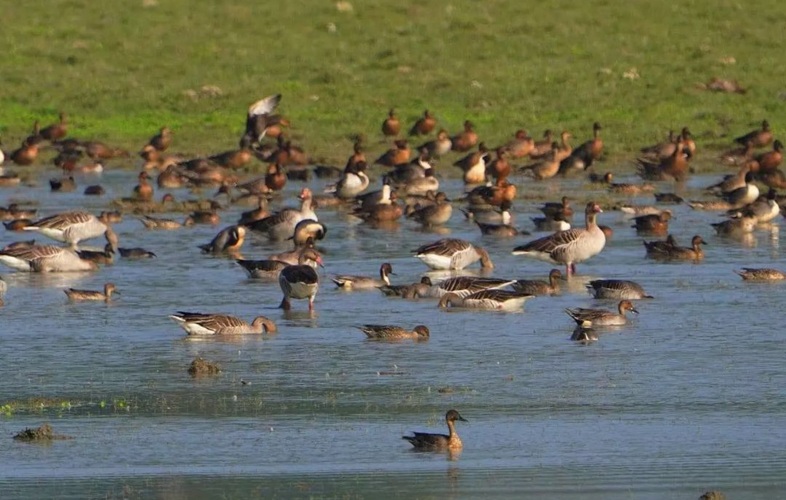
Guwahati: More than 1.05 lakh waterbirds representing 107 species were recorded during the 7th Kaziranga Waterbird Estimation carried out last winter across the Kaziranga–Laokhowa–Burhachapori floodplain complex, officials said on Wednesday.
According to authorities from Kaziranga National Park and Tiger Reserve, the findings reinforce the region’s status as one of the most important wintering grounds for waterbirds in the Brahmaputra valley and a key ecological hub along the Central Asian Flyway.
The survey revealed a rich diversity of species groups, including grazing waterfowl, dabbling and diving ducks, marsh-dependent birds, waders, storks, cormorants and fish-eating raptors.
Officials said this diversity reflects the varied wetland habitats of the landscape, ranging from deep perennial beels and shallow mudflats to vegetated marshes and riverine corridors spread across a connected floodplain system.
Migratory geese formed a major share of the population, with 19,133 Bar-headed Geese and 6,533 Greylag Geese recorded, together contributing over 25,000 birds to the total count.
Large numbers were also documented for species such as Gadwall (5,283), Green-winged Teal (5,220), Ferruginous Pochard (5,594), Lesser Whistling Duck (6,700) and Grey-headed Swamphen (6,286).

Officials noted that the overall count far exceeds the 20,000-waterbird benchmark used under Ramsar Criterion 5 to identify wetlands of international importance, underlining the global ecological value of the landscape.
The survey also recorded several species of global conservation concern.
Endangered species such as the Greater Adjutant (Leptoptilos dubius) with 66 individuals and the Pallas’s Fish Eagle (Haliaeetus leucoryphus) with 61 individuals were documented.
ALSO READ: Four-month drought puts Assam’s tea industry at risk, early flush faces major setback
Vulnerable species, including the Lesser Adjutant (Leptoptilos javanicus) with 257 birds, and near-threatened species such as the Ferruginous Pochard (Aythya nyroca) with 5,594 birds and the Oriental Darter (Anhinga melanogaster) with 1,102 birds, were also recorded.
Many of these species are protected under different schedules of the Wildlife Protection Act, 1972, strengthening the statutory responsibility for their conservation, a report said.
Key wetlands such as Rowmari Beel and Donduwa Beel emerged as major congregation sites, while wetlands in the Agoratoli and Bagori ranges, including Sohola and its associated beels, made significant contributions to both bird numbers and species diversity, the survey report noted.