










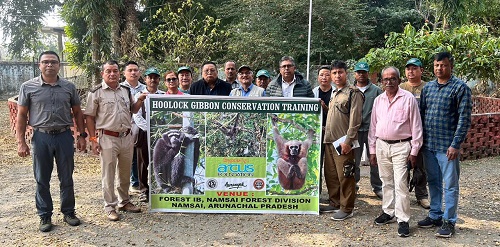
Guwahati: Leading biodiversity conservation organisation Aaranyak, in collaboration with the Namdapha National Park & Tiger Reserve Authority and with support from the Arcus Foundation, organised a Hoolock Gibbon conservation training programme at the headquarters of the Namsai Forest Division in Arunachal Pradesh on February 23, 2026.
The training aimed to familiarise forest personnel with the Western Hoolock Gibbon (Hoolock hoolock), India’s only ape, and to strengthen their motivation and capacity for its conservation. The Western Hoolock Gibbon is an endangered primate species found in seven northeastern states of India (except Sikkim).
Its distribution is largely restricted to the south bank of the Brahmaputra River and areas east of the Dibang River system. The Namsai Forest Division is considered a potential habitat for this endangered species. This workshop was the first of its kind in both the Namsai Forest Division and the Namsai district.
The programme was inaugurated by Tabang Jamoh, Divisional Forest Officer (DFO) of Namsai Forest Division, and coordinated by Nandita Medhi, Consultant, Primate Research and Conservation Division, Aaranyak.
In his inaugural address, Mr. Jamoh welcomed the participants and expressed his appreciation to Aaranyak for initiating the training in the interest of Western Hoolock Gibbon conservation in Namsai. He urged participants to actively engage in the sessions and apply their learnings in the field.

Highlighting that the Hoolock Gibbon is the state animal of Arunachal Pradesh, he emphasised the collective responsibility of the state’s people to safeguard the species. He also encouraged the forest staff to develop practical skills in the use of Global Positioning System (GPS) and Geographic Information System (GIS) tools for gibbon conservation and broader biodiversity management.
Also Read: Aaranyak conducts Hoolock Gibbon awareness programmes in Arunachal Pradesh’s Namsai.
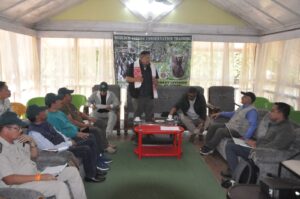
Dr. Dilip Chetry, Senior Primatologist, Director and Head of the Primate Research and Conservation Division, Aaranyak, and Vice Chair of the IUCN Primate Specialist Group, South Asia, served as the resource person for the first session. He discussed the current conservation status of the Western Hoolock Gibbon, the threats it faces, and its conservation priorities. Dr. Chetry also elaborated on various methods of population estimation and urged the Arunachal Pradesh Forest Department to consider the species as a flagship for regional biodiversity conservation.
Alok Kumar, Range Officer of Tengapani Range, initiated and coordinated an interactive session on Hoolock Gibbon conservation.
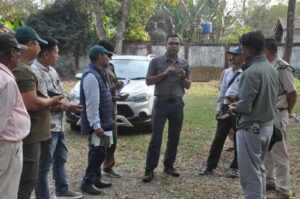
The second session was led by Arup Kumar Das, Assistant Director and Head of the Geo-Spatial Technology and Application Division at Aaranyak, who highlighted the use of GPS in wildlife research and monitoring. A hands-on GPS training session was conducted by Mr. Das, along with Simanta Medhi and Akshay Kumar Upadhyaya, covering practical components such as recording waypoints, tracking routes, and assessing proximity.
20 participants attended the training, including forest staff from six ranges under the Namsai Forest Division: Namsai, Manabhum, Tengapani, Chowkham, Medo, and Wakro Forest Ranges. The programme concluded with a vote of thanks, followed by the distribution of soft-copy study materials and posters on Hoolock Gibbon conservation.