










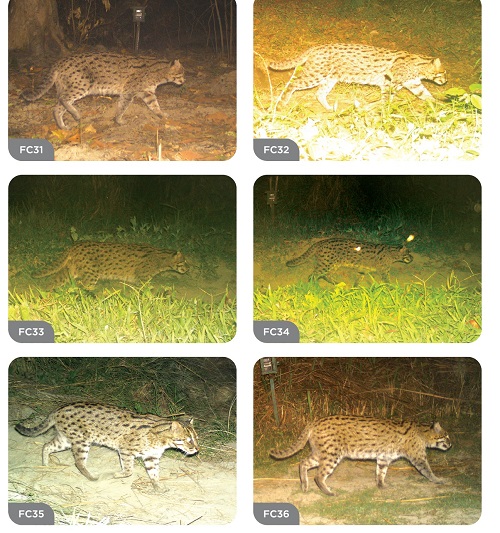
Kaziranga National Park and Tiger Reserve in Assam has now been identified as a significant stronghold for the endangered Fishing Cat.
In the first scientific assessment of the species in the park, researchers have identified at least 57 individual Fishing Cats (Prionailurus viverrinus) spread across more than 450 sq km of Kaziranga’s floodplain ecosystem.
The findings were made public on February 22 to coincide with Fishing Cat Day. Awareness drives and outreach initiatives were organised to highlight the species’ conservation needs.
Conducted by the Tiger Cell of Kaziranga in collaboration with Tiasa Adhya, a scientist of Fishing Cat Project, the study examined the camera-trap images available from past All India Tiger Estimation data with two main objectives: determining if Fishing Cats are rare or common in Kaziranga, and estimating the minimum number of these species present in the UNESCO World Heritage Site.
The primary aim was to access whether the species is rare in Kaziranga and establish a minimum population estimate. The study establishes the first scientific benchmark for long-term monitoring of Fishing Cats in Kaziranga.
Detailed image scrutiny confirmed 57 unique individuals. Since the camera traps were originally deployed to monitor large carnivores such as tigers, officials indicated that the actual population could be higher than the recorded figure.

Also Read: Under-construction bridge on NH-27 in Assam’s Dima Hasao collapses; one injured
“Thrilled to share that Kaziranga has recorded over 57 fishing cats—one of the highest ever in floodplain ecosystems! The enigmatic Meseka from Assamese folk tales symbolises our healthy ecosystems & natural heritage,” Assam’s environment, forest and climate change minister Chandra Mohan Patowary posted on social media while releasing the promotional video.
Dr Sonali Ghosh, Field Director of Kaziranga, said the results highlight the importance of the park’s floodplains beyond megafauna.
“Our findings position Kaziranga as a vital ark for this wetland specialist in the Brahmaputra floodplains,” she said.
Protected under Schedule I of India’s Wildlife Protection Act, 1972, the Fishing Cat is one of the few wild felids specially adapted for aquatic hunting. Often seen as a shadowy presence in wetlands, the animal is rarely studied in floodplain ecosystems.
They face threats from habitat loss and hunting, with disappearances noted in Vietnam and Java. South Asia holds its global core population, tied to lowland river basin wetlands. It depends heavily on lowland river basin wetlands, habitats that are increasingly threatened by encroachment, infrastructure development, altered river systems and climate change.