










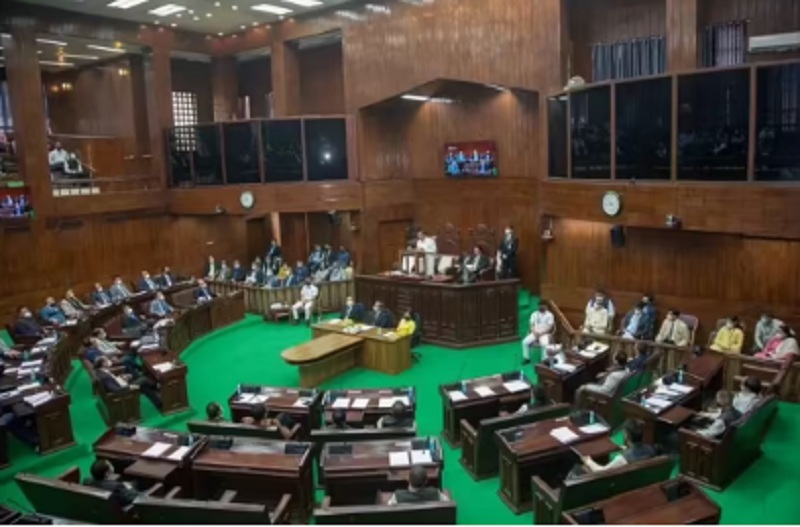
Aizawl: The Mizoram Assembly has approved a new legislation aimed at tightening controls over illegal occupation of government and community lands, marking a significant overhaul of the state’s land protection regime.
The proposed law — the Mizoram (Prevention of Public Land Encroachment) Bill, 2026 — was tabled by Land Revenue and Settlement Minister B Lalchhanzova. It seeks to repeal and replace the Mizoram Prevention of Government Land Encroachment Act, 2001, which the government said had limitations in scope and enforcement.
Speaking during the debate, Lalchhanzova said the 2001 Act suffered from structural weaknesses, particularly its limited interpretation of “government land.” Because of this narrow scope, several categories of land — including those managed by village councils and community institutions — were left outside effective legal safeguards.
He noted that areas such as village council lands, public playgrounds and grazing fields often lacked explicit statutory backing, making them susceptible to encroachment. Such illegal occupation, he said, not only results in loss of public assets but also fuels disputes and disrupts systematic development planning.
The Minister further pointed out procedural gaps in the earlier law. It did not lay down clear timelines for eviction, lacked a well-defined inquiry mechanism and offered limited avenues for appeal. Penalty provisions were also uniform, with no distinction between minor and large-scale encroachments, and there were no specific measures to address repeat violations or those aiding such offences.
The new Bill aims to correct these shortcomings by broadening the definition of “public land” and placing community and village lands firmly within the ambit of legal protection. It also proposes to include grazing grounds and properties held by government-supported bodies under the protected category.

Under the proposed framework, any unauthorised occupation, construction or use of public land for personal or commercial benefit would be explicitly prohibited. The legislation provides for a structured adjudicatory system and clearer enforcement procedures.
Deputy Commissioners and designated Revenue Officers will be empowered to order evictions, demolish illegal structures, impose penal rent for the period of unauthorised occupation and initiate criminal proceedings against offenders. The Bill introduces graded penalties, ensuring stricter punishment for repeat offenders and cases involving large tracts of land.
ALSO READ: Mizoram govt foils major ginger subsidy fraud through early probe: Agriculture minister
Once enacted, the law will apply across Mizoram, except in areas governed by the Autonomous District Councils under the Sixth Schedule in the southern part of the state.
Highlighting the broader context, Lalchhanzova said that rapid urban growth in Mizoram has intensified land-related disputes, which have evolved into a significant administrative concern. He maintained that a stronger and more comprehensive legal framework is necessary to safeguard public resources and ensure orderly development.