










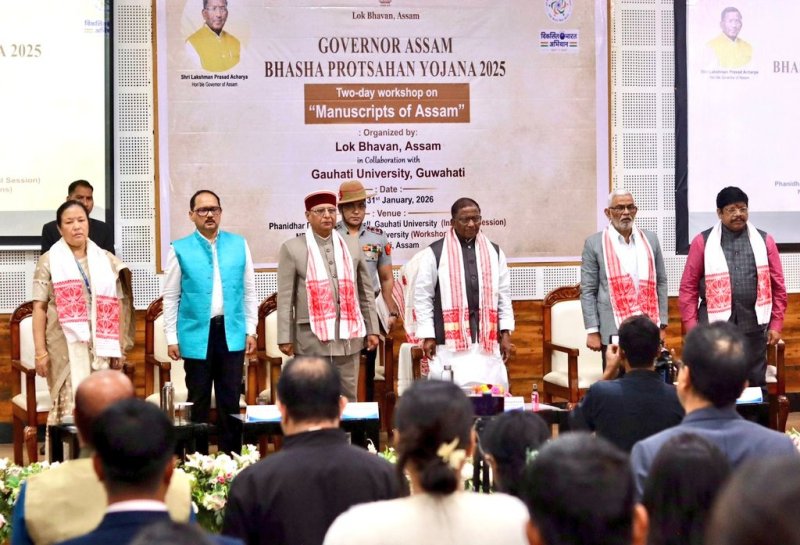
The Governor’s Bhasa Protsahan Yojana acquired renewed public visibility on January 30 and 31, 2026, when a two-day programme on the manuscripts of Assam was held at Gauhati University. Those two dates marked more than a scholarly gathering; they symbolised a conscious reaffirmation by the state that its languages, scripts and literary traditions remain central to its identity and future.
Organised by Lok Bhawan, Assam, in collaboration with the university, the programme brought together scholars, administrators and custodians of heritage to reflect on how Assam’s vast manuscript wealth can be preserved, studied and shared in a rapidly changing world.
The genesis of the Governor’s Bhasa Protsahan Yojana lies in a growing awareness that language is the primary carrier of civilisational memory. Assam is home to an extraordinary range of linguistic traditions, many of which are recorded in manuscripts scattered across sattras, temples, libraries and private collections.
For generations, these texts survived through devotion and custom, but without a systematic framework they remained vulnerable to decay, dispersal and neglect. Launched in 2024, the yojana sought to fill this gap by creating a structured, state-supported initiative that would promote languages, encourage scholarship and ensure scientific documentation and conservation of manuscripts. It was conceived not merely as a cultural scheme, but as a long-term investment in intellectual continuity.
By the time the January 2026 programme was convened, the yojana had evolved into a multidimensional effort linking culture with governance and public engagement. The discussions at Gauhati University repeatedly returned to the idea that manuscripts are not inert artefacts but living repositories of knowledge.
They contain reflections on philosophy, history, governance, science, medicine, music and everyday life, offering insights that remain relevant even today. The Governor’s consistent emphasis on manuscripts as “living traditions of knowledge” framed the deliberations, encouraging participants to think beyond preservation as storage and towards preservation as active transmission.

The utility of the Bhasa Protsahan Yojana to the state becomes evident in this broader vision. Assam’s linguistic diversity, often viewed through the prism of administrative complexity, is reimagined as a source of strength. By promoting research, translation and dialogue among languages, the yojana fosters cultural confidence and mutual respect among communities.
Initiatives that connect Assamese literature with other classical and regional languages reinforce the idea that pride in one’s mother tongue can coexist with national integration. For students and young researchers, the scheme opens pathways to engage academically and professionally with indigenous languages, ensuring that global exposure does not come at the cost of cultural disconnection.
The January 2026 programme also underlined how language and heritage intersect with diplomacy and development. Sessions on Tai and other manuscript traditions highlighted Assam’s historical and cultural linkages with Southeast Asia, resonating strongly with India’s Act East policy.
Preserving and studying these texts is therefore not only an academic responsibility but also a strategic opportunity, positioning Assam as a cultural bridge between India and its eastern neighbourhood. In this sense, the Bhasa Protsahan Yojana extends its relevance beyond state boundaries, aligning cultural preservation with broader national and international objectives.
An important institutional backdrop to these initiatives has been the transformation of Raj Bhawan into Lok Bhawan in December 2025. This change was not merely symbolic; it represented a deliberate effort to shed colonial-era terminology and recast the Governor’s residence as a people-centric institution. The shift from “Raj” to “Lok” signalled that governance must be rooted in public participation and accessibility. That the 2026 manuscript programme was organised by Lok Bhawan reinforced this ethos, conveying that the preservation of language and literature is a shared civic responsibility rather than an elite academic concern.
Within this people-oriented framework, the BhasaProtsahan Yojana sits alongside other initiatives of the Governor aimed at social inclusion and human development. Programmes that support talented but underprivileged students (Viswakarma Award), recognise the achievements of persons with disabilities, or encourage youth leadership reflect a consistent emphasis on empowerment.
Together, these efforts portray the Governor’s office as an active facilitator of opportunity, culture and dialogue. Language promotion, in this context, is not an isolated cultural exercise but part of a wider commitment to inclusive and participatory development.
The January 2026 programme also brought into focus the technical and ethical dimensions of manuscript preservation. Assam’s manuscript heritage is distinctive not only for its content but also for its material form, particularly the use of Sanchipat prepared through indigenous techniques.
Scholars pointed out that conservation methods suitable for paper-based archives can be harmful to such materials, and that traditional practices often offer more sustainable solutions. This insight reinforces a core principle of the BhasaProtsahan Yojana: that progress need not discard tradition, and that innovation can emerge from a respectful engagement with inherited knowledge systems.
In terms of the global context, the alignment with UNESCO’s “Memory of the World” guidelines provides a strategic advantage. UNESCO emphasizes that “access encourages protection,” and the BhasaProtsahan Yojana’s focus on workshops and public awareness directly fulfills this mandate.
By bringing together institutions like the Asiatic Society of Kolkata and the British Library in the United Kingdom, the state can ensure that its conservation techniques are interoperable with international standards. This is particularly important for the preservation of Sanchipat, which requires approaches different from the paper-based archival practices typical of Western institutions. Such alignment ensures that Assam’s heritage can be both locally grounded and globally recognised.
Adopting these global best practices has tangible benefits for the state. Systematic cataloguing and digitisation can prevent loss, enable research collaboration and connect local collections with international scholarly networks. At the same time, the yojana recognises that digitisation is a means rather than an end. Physical preservation, contextual understanding and continued cultural use of manuscripts remain essential. The aim is to strike a balance between access and sanctity, between technological efficiency and cultural sensitivity.
The long-term success of the Bhasa Protsahan Yojana will depend on sustained institutional collaboration. Universities, cultural bodies, government departments and community custodians must work together to create a supportive ecosystem. Encouragingly, the programme has already fostered such synergy.
Training in script reading, documentation and conservation equips a new generation of scholars to unlock the knowledge embedded in ancient texts. For communities that have long safeguarded these manuscripts, professional support offers reassurance that their heritage will endure without losing its meaning.
Ultimately, the Governor’s Bhasa Protsahan Yojana represents a quiet yet profound shift in how Assam relates to its past and future. By foregrounding language and literature within governance, it affirms that development is incomplete if it neglects cultural foundations.
The January 2026 programme demonstrated that manuscripts and languages are not burdens of history but assets of identity. In transforming Raj Bhawan into Lok Bhawan and opening its doors to such initiatives, the Governor’s office has reinforced the idea that culture belongs to the people and flourishes best when nurtured collectively.
ALSO READ: The February Bargain: India’s calculated gamble on America
In a globalised world that often prizes uniformity, Assam’s experience offers a compelling alternative. It shows that safeguarding linguistic heritage can coexist with educational reform, social inclusion and international engagement. Rooted in local realities yet informed by global best practices, the Governor’s Bhasa Protsahan Yojana stands as a model of how a society can remember who it was, engage confidently with the world, and imagine clearly who it aspires to become.