










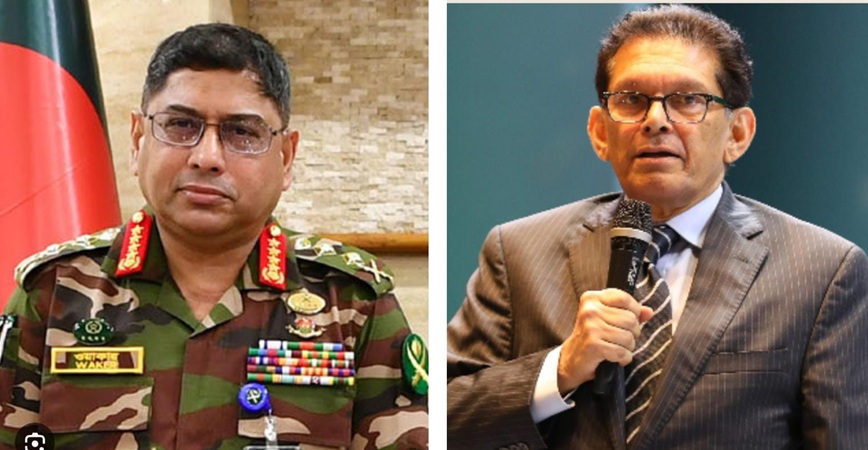
Khalilur Rahman, Bangladesh’s controversial National Security Adviser during the Mohammad Yunus-led interim regime, continues to lead a charmed life.
The shadow of the United States will remain in the form of Khalilur Rahman who was at the centre of one controversy too many when he helmed the NSA’s job.
Khalilur Rahman’s inclusion in Tarique Rahman’s Council of Ministers, who took oath of office and secrecy today, appears to be an outcome of a murky behind-the-scenes deal-making.
Till last evening, Khalilur, who negotiated Bangladesh’s trade deal with the US and the proposed purchase of 25 Boeing aircraft, did not figure even remotely as a probable, but his inclusion today on the ‘technocrat’ quota was a bolt out of the blue, indicating that the US ‘deep state’ continues to exercise strong influence on Tarique Rahman.
Dhaka’s corridors of power and BNP circles are abuzz with whispers even as many ruling party leaders expressed complete surprise and shock at Khalilur Rahman’s upgradation.
The immediate implication of this controversial decision is serious for Khalilur Rahman – he has been appointed the foreign minister – will continue to needle Army chief Waker-uz-Zaman.

The Khalil-Waker feud, which began in May 2025 following the then NSA’s rather unusual interest and penchant for the Rakhine “humanitarian corridor”, and was never resolved till Bangladesh went to the polls on February 12, will likely deepen.
In the summer of 2025, after Khalilur Rahman pitched for the controversial “humanitarian corridor”, Gen Zaman responded angrily, saying there would be “no bloody corridor”.
To drive home the point that he meant business, Gen Zaman, otherwise a softspoken but firm officer, issued instructions banning Khalilur Rahman’s entry into Dhaka Cantonment.
That ban will likely continue, pitting an ‘unelected, planted minister’ with the Army leadership which was under the impression that the BNP’s victory at the hustings would end months of uncertainty amid a host of geopolitical anxieties involving Bangladesh, Myanmar, India, the US and China.
More recently, Khalilur Rahman sought to effect a coup in the Army by trying to shift Principal Staff Officer in the Armed Forces Division, Lieutenant General S M Kamrul Hassan, as the Chief of General Staff, a position that was vacated following the retirement of Lt Gen Mizanur Rahman Shamim.
Khalilur Rahman’s plan was to isolate Gen Zaman by also moving Quarter Master General Lt Gen Mohammad Faizur Rahman in Lt Gen Hassan’s place. But Gen Zaman wanted ARTDOC General Officer Commanding Lt Gen Mainur Rahman as the next CGS.
The next move that Khalilur Rahman and Mohammad Yunus tried to make was to transfer 24th Infantry Division GOC Maj Gen Mir Mushfiqur Rahman as the CGS.
ALSO READ: New Shillong City to generate over 1.5 lakh jobs, says Meghalaya CM
This happened when Gen Zaman saw an opportunity to place Bangladesh’s the then ambassador to Lebanon Maj Gen Mohammad Jubayer Salehin as the CGS.
However, this did not materialise as Maj Gen Salehin opted to go in for the mandatory ‘leave preparatory to retirement’ (LPR) on February 1 following his return from Lebanon.
The CGS post has lain vacant since Lt Gen Shamim bowed out of service on January 31, 2026.
While Khalilur Rahman will not be able to directly – and adversely – impact the Army’s functioning, he will remain a thorn in the flesh of the military leadership who exercise strong influence over Bangladesh’s foreign policy.
Some Dhaka-based defence analysts foresee a “shouldering of arms” among the seniormost generals – barring Lt Gen Hassan and Lt Gen Faizur Rahman – as a “rear guard” and “unified response” to Khalilur Rahman’s new role.
What is, however, a strong likelihood is that on his part Gen Zaman, who is slated to retire in June 2027, will try to solidify his circle of loyalists in the Army to take on any renewed threat from a powerful Khalilur Rahman who has the full backing of the US.