










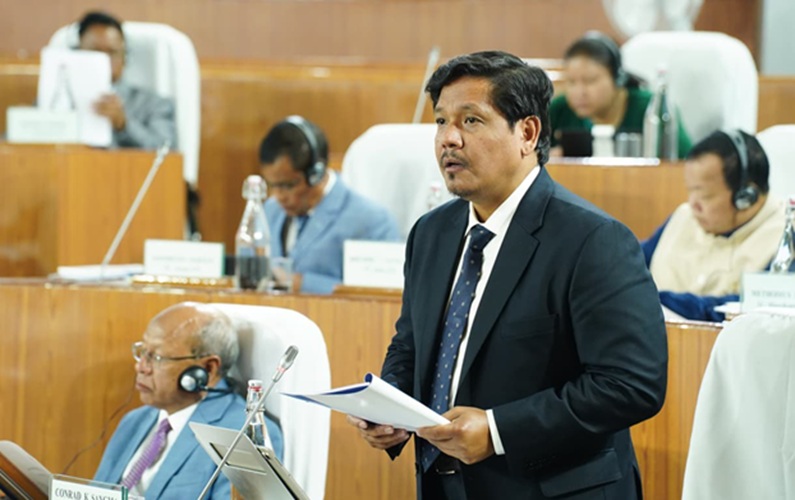
Shillong: Chief Minister Conrad K Sangma on Tuesday outlined the government’s long-term development roadmap for New Shillong Township, describing it as Meghalaya’s future growth hub and a major generator of jobs and investment.
Replying to a short duration discussion in the Assembly on ongoing developmental activities under New Shillong Township, Sangma said the rapid growth of Shillong has created pressure on infrastructure, including congestion, parking, water supply and drainage systems, challenges that are being addressed through a phased and planned approach.
He said immediate urban issues in Shillong were being tackled alongside the long-term strategy of building New Shillong as a new city to support future expansion.
The chief minister said more than Rs. 6,000 crore has been sanctioned for the development of New Shillong City, with nearly 30 per cent already utilised for on-ground infrastructure and key facilities.
Development is being implemented in phases, with the Administrative City at Mawdiangdiang nearing completion and preparations underway for the shifting of government departments this year.
He said the Knowledge City phase is being developed as an education, skill and innovation hub, while a dedicated transit-oriented development corridor is planned to connect different zones of the new city.

Sangma said New Shillong is being envisioned as Meghalaya’s economic engine, driven by four sectors — tourism, sports and culture, education and skilling, and technology — with the potential to generate over 1.5 lakh jobs and attract new industries and investments.
Addressing environmental and land-use concerns, he said the Shillong Master Plan, prepared by the North Eastern Space Applications Centre (NESAC), covers the Greater Shillong Planning Area and uses GIS-based risk mapping to restrict unsafe development in flood-prone and landslide-prone zones.
He added that community consultations were carried out with several shnong leaders and their inputs were incorporated before finalisation of the plan.
He also highlighted recent amendments to the Meghalaya Building Bye-laws banning construction on steep slopes to prevent unsafe hill development.
On infrastructure, Sangma said a Comprehensive Mobility Plan has laid out a 30-year transport roadmap for New Shillong, including a structured road grid and improved regional connectivity.
He said key road corridors are already completed or under progress and that New Shillong will benefit from regional connectivity projects such as the proposed Guwahati–Shillong–Silchar high-speed corridor and the upgrading of Shillong Airport.
Water security, he said, has been planned through a dedicated surface water system designed to serve more than four lakh people, with Phase I of the project already sanctioned and under construction.
Power infrastructure has also been strengthened with new substations and upgraded transmission lines to ensure reliable supply for future growth.
The chief minister said Phase 1 of New Shillong has already emerged as a strong administrative, education and healthcare centre, housing institutions such as the Meghalaya Secretariat, IIM Shillong, NIFT, NEIAH and NEIGRIHMS.
ALSO READ: Gurugram Police arrest Naga woman for aiding China-based cyber fraud network
He said construction of the new Meghalaya Secretariat complex and the Legislative Assembly building is progressing rapidly, positioning New Shillong as the state’s future administrative hub.
He added that the Knowledge City phase will include major IT parks, skill and innovation hubs, large cultural and sporting infrastructure and commercial zones, with development planned through public-private partnerships to generate large-scale local employment.
Sangma said the Town and Country Planning framework will ensure that development also benefits surrounding communities, with traditional institutions and local bodies being formally represented in planning processes.
Concluding his reply, the chief minister said New Shillong is not just an urban expansion project but a long-term development vision for Meghalaya, aimed at balanced growth, environmental sustainability, economic transformation and inclusive opportunities, ensuring that communities across the state benefit directly from the project.