










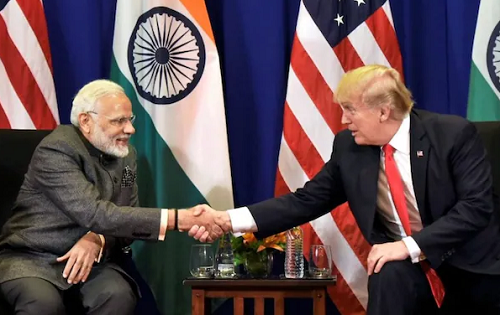
On February 9, 2026, the White House unveiled a fact sheet trumpeting what it called a “historic trade deal” with India, complete with a joint statement that promised to reset years of tariff tensions and open fresh avenues of economic cooperation. Yet barely three days later, as opposition leaders in Delhi denounced it as a capitulation and farmer groups took to the streets, the agreement’s true nature came into sharper focus: this is no finished treaty, but a fluid framework for an interim pact still awaiting detailed negotiation and signatures. What has been announced is a high-stakes outline—significant American tariff relief in exchange for Indian market openings, big-ticket purchases, and subtle shifts in geopolitical posture—yet its final shape remains negotiable, as rapid revisions to the White House language already demonstrate.
At its heart, the deal delivers immediate breathing room for Indian exporters battered by the 2025 tariff spiral. Many Indian goods faced an effective 50 percent duty in the American market: a 25 percent “reciprocal” tariff layered atop an additional 25 percent punitive levy tied to India’s purchases of discounted Russian oil. The new framework slashes that combined burden to 18 percent across key sectors such as textiles, apparel, leather, footwear, chemicals, and certain machinery. For labour-intensive clusters in Tiruppur, Ludhiana, and Agra, the change is electric. Orders that had drifted to Vietnam or Bangladesh are reportedly returning, margins are stabilising, and the rupee has found unexpected support. Indian pharmaceuticals, gems and jewellery, and auto components stand to gain further as the full bilateral trade agreement negotiations unfold, with hints of preferential quotas and eased non-tariff barriers. In a world where the United States still represents a $30-trillion market, restored access feels less like charity and more like oxygen.
Yet the relief comes with strings—some visible, others still being knotted. In return, India has agreed to eliminate or sharply reduce tariffs on a wide array of American industrial goods and a carefully selected but politically explosive basket of agricultural products: distillers’ dried grains and red sorghum for animal feed, tree nuts, fresh and processed fruits, soybean oil, wine and spirits. While the government insists that core sensitivities—dairy, major cereals, pulses, and meat—remain protected through quotas and exclusions, farmer organisations are unconvinced. They point to the vast subsidy gap between American agribusiness and Indian smallholders, the vulnerability of Himalayan apple growers and northeastern horticulturists, and the risk of import surges that could depress already fragile prices. Protests have erupted, with some comparing the deal to the contentious farm laws of 2020. The opposition, seizing the moment, has branded the entire package a “sell-out,” accusing the ruling dispensation of trading rural livelihoods for urban export gains.
Equally contentious is the $500-billion “intention” for India to purchase American energy products, aircraft, technology, and coking coal over the next five years. The wording was softened from an earlier, firmer “commitment” after Indian pushback, yet the scale remains staggering—roughly doubling current import levels from the United States in targeted sectors. Proponents argue much of this represents re-routing rather than net new spending: shifting oil purchases away from Russia toward American or Venezuelan sources, for instance. Critics counter that it risks widening the bilateral trade imbalance and handing Washington future leverage if delivery targets slip.
Perhaps the most geopolitically charged element is the implicit linkage between tariff relief and energy sourcing. The White House fact sheet initially framed the removal of the punitive 25 percent duty as recognition of India’s “commitment to stop purchasing Russian Federation oil.” Indian officials have been notably silent on any such explicit pledge, and Moscow has reacted with cautious concern rather than outright alarm. The joint statement itself contains no direct reference to halting Russian crude, and analysts note that India’s defence relationship with Russia—rooted in legacy platforms, spare parts, and joint projects like BrahMos—remains structurally indispensable for years to come. Still, the episode underscores a narrowing of New Delhi’s manoeuvring room. In an era of intensifying great-power rivalry, access to the American market now carries an unspoken price tag of greater alignment on Russia policy, even as India continues to insist on strategic autonomy.
Also Read: 51 Kuki students evacuated from JNV Ukhrul amid rising ethnic conflicts

This compulsion is not born of weakness alone but of cold strategic calculus. With China’s shadow lengthening across the Indo-Pacific, deeper economic integration with the United States serves as both insurance and signal. The deal’s clauses on supply-chain resilience, rules of origin designed to curb third-country trans-shipment (read: China), and economic-security cooperation point toward a quiet convergence against “non-market policies.” For a country seeking to position itself as the manufacturing alternative in a fragmenting global order, the benefits—potential FDI inflows, technology cooperation, and a stronger Quad pillar—are compelling. Yet they come at the cost of complicating ties with an old and reliable partner in Moscow, whose discounted oil has helped cushion inflation and refinery margins since 2022.
Digital trade and regulatory commitments add another layer of complexity. The framework speaks of “robust” bilateral rules to address “discriminatory or burdensome practices,” language that echoes American pressure on data localisation, cross-border data flows, and the digital services tax. Early drafts reportedly went further; revisions walked some claims back, but the direction of travel is clear. India’s ability to regulate Big Tech on its own terms may gradually erode as negotiations toward the full bilateral trade agreement intensify.
None of this is yet set in stone. The interim nature of the announcement—coupled with the fact sheet’s swift edits on pulses, agricultural wording, and purchase language—offers New Delhi valuable runway. In the weeks and months ahead, Indian negotiators can harden safeguards for vulnerable farmers, clarify conditionality around Russian oil, and shape digital rules more aligned with national priorities. The real test will lie not in the headlines of February 2026 but in implementation: whether tariff relief translates into genuine manufacturing depth and job creation, whether agricultural openings are paired with serious rural infrastructure and income support, and whether the geopolitical tilt is managed without fracturing indispensable relationships.
For now, the deal sits at the intersection of pragmatism and protest. The ruling party hails it as a masterstroke that has defused a damaging trade war and anchored India more firmly in the American economic orbit. The opposition sees surrender of sovereignty and rural interests. The truth, as ever in such bargains, lies somewhere in the contested middle: a classic strategic trade-off in which India purchases stability and market access by ceding some policy space and accepting new vulnerabilities. If New Delhi plays its cards with skill—locking in gains, ring-fencing risks, and communicating transparently at home—the February framework could mark the beginning of a more mature economic partnership. If not, the domestic backlash and external dependencies may prove more enduring than the tariff relief itself. The coming months of fine print and political theatre will decide which narrative prevails.