










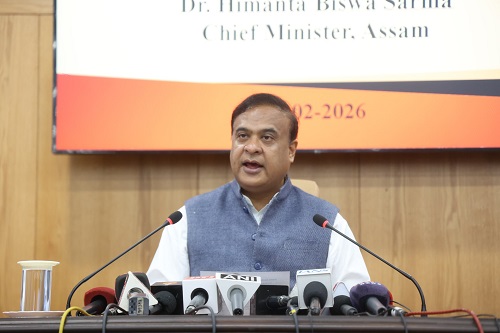
Guwahati: Assam Chief Minister Himanta Biswa Sarma on Sunday stated that the underwater road-cum-rail tunnel between Gohpur and Numaligarh would be constructed in a period of five years, adding that it will be a ‘game-changing’ infrastructure project for the region.
Addressing a press conference in Guwahati’s Lok Sewa Bhawan today, CM Sarma stated that the project, which has already received approval from the Central Government, will be India’s first rail-cum-road underwater tunnel, the fourth rail-cum-road crossing over the Brahmaputra.
He also added that this will be the world’s second such project after the Fehmarnbelt link between Germany and Denmark.
Providing a comprehensive presentation about the project, the Chief Minister said, “The structure will be constructed nearly 57 metres below the Brahmaputra riverbed, making it one of the most complex infrastructure projects in the country. It will connect Gohpur on NH-15 (North Bank) with Numaligarh on NH-715 (South Bank). It will include a 15.79-km underwater tunnel and 17.91 km of approach roads, 10.15 km on the Gohpur side and 7.76 km on the Numaligarh side. The construction period has been set at five years.”
Also Read: PM Modi attacks Congress over Northeast neglect, insurgency in Assam
“The project would generate around 80 lakh human-days of employment during construction. The tunnel will consist of twin tubes for road and rail traffic, along with a separate escape passage. Cross-passages will be provided every 500 metres to ensure safety during emergencies,” he added.

CM Sarma also stressed that after the completion of the project, travel time, which now takes nearly six hours, will come down to about 20 minutes. It will enhance border connectivity and cross-border trade, reduce the distance between Dimapur in Nagaland and Itanagar in Arunachal Pradesh from 260 km to approximately 170 km, provide high-speed connectivity between Assam and Arunachal Pradesh, the Chief Minister added.
He further elaborated stating that the project will be executed with the cooperation of the Government of India, the Indian Army, and the National Highways & Infrastructure Development Corporation Limited (NHIDCL). The Railways will also extend support for its construction. The Ministry of Defence will contribute around 20 percent of the project cost due to its strategic nature, while the state government will also support land acquisition and implementation.