










By Enayet Kabir
An uphill task awaits the Bangladesh Election Commission after the much-awaited February 12 elections. Will the panel be able to reconcile the referendum vote numbers and the candidate vote counts across all centres? The election results have been announced based on a prior understanding between the July allied powers and the tri-party government unity alliance.
Bangladeshis who remember the 1979 “rigged” election are seeing a repetition. The Election Commission was able to perform smart election engineering due to the consensus within the tri-party alliance. The BNP has acknowledged the Jamaat-e-Islami and the NCP as the opposition. Consequently, while making the election appear fair, manipulating the results became easy.
Because it was a “negotiated election,” there were no major casualties anywhere. According to the agreement, the BNP has won an absolute majority. The Jamaat-e-Islami’s tally stands at 68 seats. The NCP managed three.
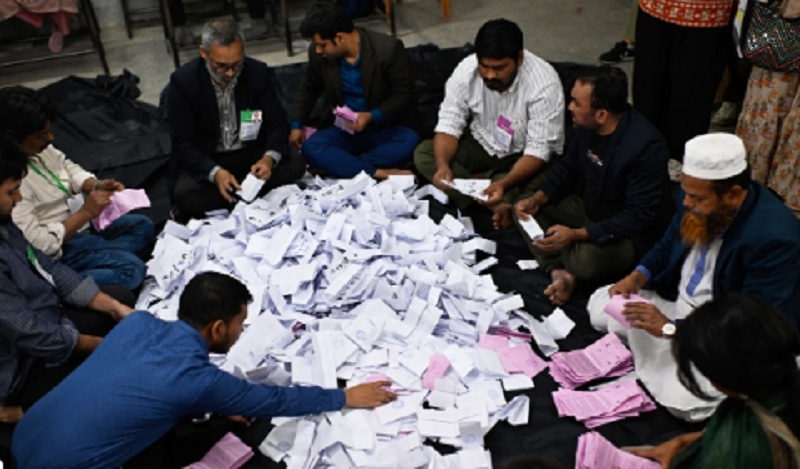
How many genuine votes were actually cast? Until 11:00 am, the Election Commission stated it was 14.96 percent across 32,000 centres. By 12:00 PM, that figure jumped to 32.88 percent at only 32,789 centres. Ballots were shown to be over 30 percent in Gopalganj, Shariatpur, Madaripur and Faridpur—which is impossible in Awami League-influenced regions. Meanwhile, the Jatiya Party could not manage to win even a single seat in the Rangpur division.
However, there was trouble over two seats in Dhaka. In Dhaka-8, the NCP’s Nasiruddin Patwary ‘won’, but Mirza Abbas was declared the victor. In Dhaka-13, the “result” went in favour of BNP’s Bobby Hajjaj. These ‘anomalies’ are now an open secret. The Jamaat and the NCP are “angry” because, in many other seats, one person’s “mangoes” were put into another’s “basket.”
The “defeated” Jamaat in this ‘rigged’ election might now issue threats of “not attending parliament” or “launching a strong movement”. These are merely political statements. They say such things to keep their “grassroots activists” energised. They will never take a stand against their most credible political “shelter,” the BNP. They are preparing for a long-term “Islamic revolution.”

They are confident in implementing the “July Charter” through the BNP. The NCP didn’t have a bigger political target than this; they secured six seats, including the one won by Nahid Islam. Do they deserve these many seats? Given their organisational strength, isn’t this more than enough?
The core ‘electoral engineering’ happened out of everyone’s sight. If the Jamaat had started “moving” since last night, the engineering would have been subtler and smarter; it would have been harder to detect. No “upsets” were allowed to happen—meaning none of the “big” leaders lost.
The result manipulation was done in a very precise manner; only the visible irregularities favouring BNP candidates have come to the fore. In Rangpur Sadar, Jatiya Party’s GM Quader ‘lost’, which is unbelievable. Conversely, in Brahmanbaria, Gono Songhoti’s Zonayed Saki ‘won’.
Acknowledging Bangladesh’s political realities, the Jamaat and the NCP played the lead roles in bringing Tarique Rahman back to the country. The Jamaat knows very well that Bangladesh is not yet ready for an ‘Islamic revolution’. The party’s political wing is not yet strong within the military. It is also not yet capable of running a government. NCP’s Nahid Islam was an advisor in the interim government; he knows the weight of the ‘chair’ well. It wouldn’t be surprising to see both Jamaat and the NCP in a ‘Unity Government’ led by Tarique Rahman.
Was the primary goal of the military and the tri-party alliance—to make the Awami League irrelevant—achieved? All three parties were “persecuted” by the Awami League, so they wanted it out of the electoral contest. However, a massive number of voters abstained from voting, registering a silent protest against the “rigged” election.
Although the Awami League ran a ‘No Boat, No Vote’ campaign to discourage people from going to the polls, and a few isolated voices on social media announced they would resist an election without the Awami League, the election went ahead. About 20-30 percent of the public ignored the Awami League’s campaign and voted.
The last time the public showed genuine interest in an election was in 2008. Since the results were known in advance each time in the subsequent elections, there was no public interest. Even the 2018 election, involving all parties, lacked public interest because people knew the Awami League would form the government. This time, the failure of the ‘No Boat, No Vote’ campaign did not help the Awami League.
It is not yet clear whether the Awami League’s return will be easy after the election. In fact, it doesn’t seem like the Awami League itself believed in the ‘No Boat, No Vote’ campaign. They too wanted an election to happen ‘by any means’ so that a political government could be formed.
Yesterday’s election is not just good news for the Awami League; it could be a blessing in disguise. The good news for them is that Mohammad Yunus may finally depart. Until Yunus’s departure, there will be no opportunity for the Awami League’s return. With a BNP victory, a smooth context for the Awami League’s return has been created.
The Awami League knows how to make a comeback and take control of the streets under a political government. In the subcontinent’s history, the Awami League has been the most aggressive opposition party. It has the experience of keeping both the BNP and Jamaat ‘caged’.
Members of a political government have to stay in the country and face opposition from within. The majority of the Yunus-led interim government are “foreigners” (expats/outsiders); they landed in Bangladesh to enjoy the trappings of power and will flee when they sense danger.
ALSO READ: PM Modi hails BNP victory in Bangladesh, seeks stronger bilateral ties
However, it doesn’t seem like the “fugitive” Awami League leaders will start packing their bags to return just yet. Because the winners of this rigged match might start chanting ‘long live electoral engineering’ instead of ‘Inquilab Zindabad’.
(The writer is a political and economic analyst)