









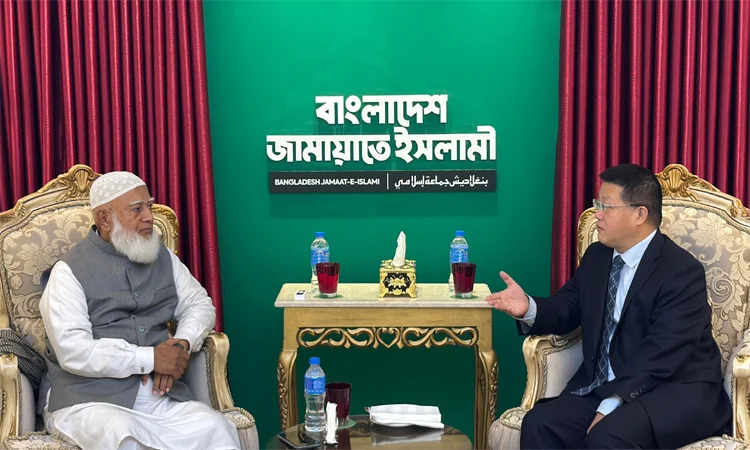
On January 12, Chinese Ambassador to Bangladesh, Yao Wen, unexpectedly attended a winter clothing distribution programme organised by the Jamaat-e-Islami.
The Chinese diplomat had all praise for Jamaat’s “humanitarian” activities—particularly its orphanages and educational institutions—raised many eyebrows.
The meeting between the Chinese Ambassador and the Jamaat was not an isolated gesture. The diplomat seems to have responsibilities beyond his ambassadorial tasks.
On September 2, 2024, less than a month after the Yunus-led interim government was installed following the student movement, the Chinese ambassador had visited Jamaat’s central office.
The Chinese Communist Party went further by formally inviting the Jamaat leaders to Beijing.
These developments signal a significant shift in Beijing’s engagement with Islamist actors in Bangladesh.

Did the people of Bangladesh forget that China’s evolving relationship with Jamaat is rooted in a troubled historical context?
In 1971, China had vehemently opposed Bangladesh’s independence and vetoed its entry into the United Nations until 1974.
During the Liberation War, Jamaat-e-Islami had collaborated with Pakistan’s genocidal forces, participating in some of the worst atrocities witnessed since the Holocaust.
Unfortunately, China recognised Bangladesh only after the assassination of Sheikh Mujibur Rahman, the country’s founding father, underscoring the complexity of its political alignments.
Founded in the early 1940s in undivided Punjab, Jamaat-e-Islami initially opposed the creation of Pakistan.
Interestingly, after the Partition, it reinvented itself as a guardian of “Islamic values,” often in their most distorted form.
Its role in orchestrating violence against the Ahmadiyya community in Lahore in 1953—resulting in over 2,000 deaths—set a precedent for its later actions.
Banned and reinstated multiple times, Jamaat acted as an auxiliary force for the Pakistani military in 1971. Its student wing was responsible for the systematic murder of over 1,100 Bangladeshi intellectuals in the final days before victory on December 16, 1971.
The party’s record since independence has been no less troubling. Following the Awami League’s electoral defeat in 2001 and again after its ouster on August 5 last year, Jamaat, often in alliance with the BNP, was linked to widespread violence against Hindu minorities—an established and well-documented pattern.
What makes China’s engagement with Jamaat particularly striking is the party’s silence on Beijing’s treatment of Uighur Muslims in Xinjiang.
Despite claiming to defend Islamic values and maintaining close ties with the Muslim Brotherhood and other Islamist networks, Jamaat has avoided condemning China’s mass detentions and cultural repression. This silence suggests political convenience rather than principled ideology.
To counter Indian influence, the Yunus government—reportedly shaped by Jamaat’s strategic input—has leaned sharply towards China.
Last month, Jamaat and other Islamist groups organised a mass protest near the India-Bangladesh border, led by the BNP, openly urging China to build the barrage near India’s vulnerable Siliguri Corridor.
On January 19, the Chinese Ambassador to Bangladesh, Yao Wen, also paid a courtesy call on National Security Adviser Khalilur Rahman at the Chief Adviser’s Office.
Apparently, the discussions included the Teesta River Comprehensive Management and Restoration Project and the proposed Bangladesh-China Friendship Hospital.
The Chinese Ambassador reportedly informed that he would visit the Teesta project area (close to the India – Bangladesh border), and reiterated China’s commitment to expeditiously completing the ongoing technical assessment.
Economically, Bangladesh is increasingly vulnerable. China accounts for Bangladesh’s largest trade deficit—around $16.4 billion, compared to $9 billion with India.
And now, the China, Islamist Networks, and Bangladesh is turning out to be a dangerous new equation in South Asia.