










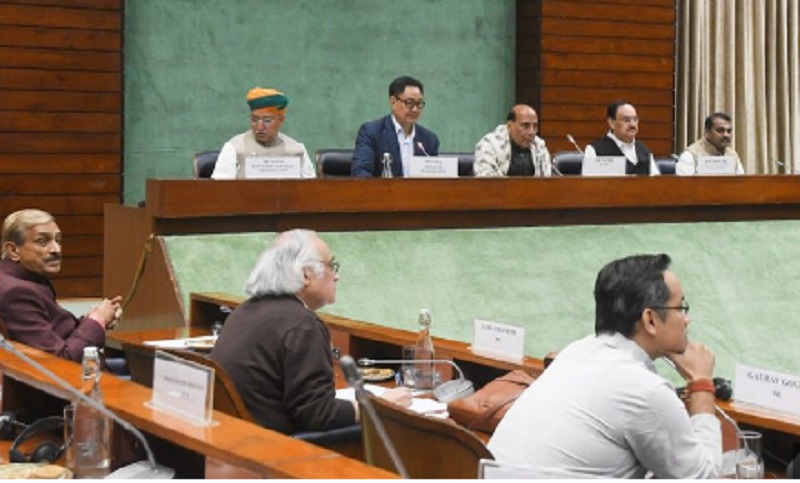
Ahead of the Budget Session of Parliament, Union Parliamentary Affairs Minister Kiren Rijiju convened an all-party meeting on Monday to discuss key issues and ensure smooth conduct of proceedings.
The meeting was held in the main committee room and aimed at building consensus and managing matters likely to arise during the session.
The Budget Session will begin on January 28 and continue till April 2, spread over two phases. The first phase will run from January 28 to February 13, while the second phase is scheduled from March 9 to April 2. In all, the session will have 30 sittings.
The Union budget would be presented on February 1, which is a Sunday. This will be Finance Minister Nirmala Sitharaman’s ninth consecutive budget. The Economic Survey will be tabled on January 29.
President Droupadi Murmu will formally inaugurate the session by addressing members of both the Lok Sabha and the Rajya Sabha.
The session is expected to witness sharp exchanges over the government’s proposal to rename the Mahatma Gandhi National Rural Employment Guarantee Act (MGNREGA) as the Viksit Bharat–Guarantee for Rozgar and Ajeevika Mission (Gramin) Act. Opposition parties have opposed the move, terming it disrespectful to Mahatma Gandhi, while the ruling Bharatiya Janata Party has defended it as a reform aimed at addressing shortcomings in the existing law.

The Budget Session also comes amid ongoing tensions in India–US trade relations. The United States imposed a 50 per cent tariff on Indian goods from August last year, including a 25 per cent penalty linked to India’s imports of Russian crude oil and defence equipment.
Although both sides continue discussions and publicly describe bilateral ties as cordial, a comprehensive trade agreement has yet to be finalised. Indian exports of textiles and seafood have been hit the hardest by the tariffs, with sectors such as gems and jewellery and auto components also facing pressure.
Currently, nine bills are pending in the Lok Sabha, including the Viksit Bharat Shiksha Adhishthan Bill, 2025; the Securities Markets Code, 2025; and the Constitution (One Hundred and Twenty-ninth Amendment) Bill, 2024. These are likely to be taken up during the Budget Session.