










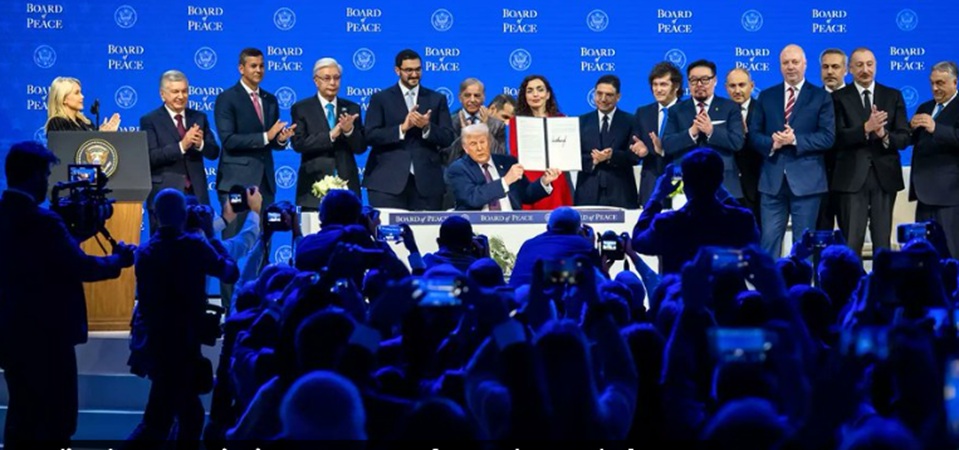
New Delhi: India was among several countries that did not attend the signing ceremony of US President Donald Trump’s proposed “Board of Peace” in Davos on Thursday, as Washington unveiled the initiative aimed at promoting lasting peace in Gaza and potentially addressing broader global conflicts.
The ceremony was hosted by Trump on the sidelines of the annual World Economic Forum in the Swiss resort town.
Prime Minister Narendra Modi was among a number of world leaders invited to join the proposed body, which was announced during the second phase of the ceasefire agreement between Israel and Hamas in Gaza.
Officials familiar with the matter said India has not yet taken a final decision on the invitation, noting that the initiative touches upon sensitive geopolitical and diplomatic issues.
New Delhi is understood to be examining various aspects of the proposal before outlining its position.
India has consistently supported a two-State solution to the Palestine issue, advocating for Israel and Palestine to coexist peacefully within secure and internationally recognised borders.

Several major global powers, including France, the United Kingdom, China and Germany, were also absent from the signing event.
Other countries such as Germany, Italy, Paraguay, Russia, Slovenia, Turkiye and Ukraine have reportedly remained non-committal on whether they will join the initiative.
According to US officials, the countries that signed on to the Board of Peace include Argentina, Armenia, Azerbaijan, Bahrain, Belarus, Egypt, Hungary, Kazakhstan, Morocco, Pakistan, Saudi Arabia, the United Arab Emirates and Vietnam.
Washington has projected the Board of Peace as a new international organisation intended to promote stability, restore lawful governance and secure long-term peace in regions affected by conflict, particularly Gaza.
The announcement has triggered speculation in diplomatic circles over whether the body could emerge as a parallel platform to existing multilateral institutions such as the United Nations.
While the initiative was initially expected to focus on overseeing governance and coordinating funding for Gaza’s reconstruction following extensive destruction during the Israeli military campaign, its charter outlines a broader mandate.
It states that lasting peace requires pragmatic decision-making, practical solutions and a willingness to move away from approaches and institutions that have delivered limited results in the past.
The top tier of the Board of Peace is expected to comprise heads of state, operating under Trump’s leadership.
The US administration has said the body will play a central role in implementing Trump’s 20-point plan for Gaza, which includes providing strategic oversight, mobilising international resources and ensuring accountability as the territory transitions from conflict to recovery and development.
ALSO READ: World-class sports facilities coming to Assam, says Himanta
The plan also envisions Gaza becoming a demilitarised, terror-free zone that poses no threat to neighbouring countries.
Last week, the White House announced the formation of a founding executive committee to operationalise the board’s vision.
The committee includes US Secretary of State Marco Rubio, former British prime minister Tony Blair, US Middle East envoy Steve Witkoff, World Bank president Ajay Banga, and Jared Kushner, Trump’s son-in-law and a key architect of previous Middle East initiatives.
Also on the panel are Marc Rowan, chief executive of Apollo Global Management, and Robert Gabriel, a US national security adviser.
The executive committee is expected to oversee an administrative body known as the National Committee for the Administration of Gaza, which will handle operational aspects linked to the initiative.