










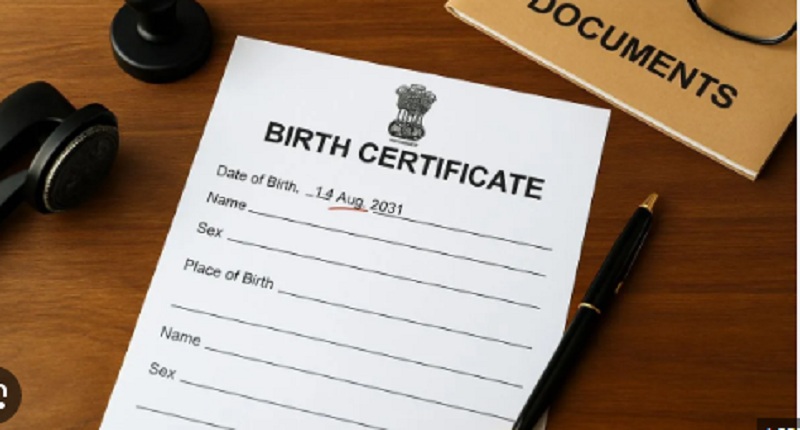
Kohima: The Nagaland government has made birth certificates the sole mandatory document for school admissions, government employment and access to a wide range of official services, following the enforcement of amended civil registration rules.
Advisor for Economics and Statistics, Evaluation and IT&C, S Sethronkyu Sangtam, said on Tuesday that the state has implemented the Nagaland Registration of Births and Deaths (Amendment) Rules, 2024, in line with changes made at the national level.
Sangtam said the registration of births and deaths is a crucial responsibility of the state, as it establishes the legal identity of individuals and supports effective planning and delivery of welfare programmes. He noted that civil registration is a continuous, permanent and compulsory process covering vital events such as births, deaths, marriages, fatal deaths and divorces.
He explained that the Registration of Births and Deaths Act, 1969 was amended by Parliament in 2023 and came into force across the country on October 1, 2023. Subsequently, the Nagaland Legislative Assembly passed the corresponding state amendment rules, which were notified on February 8, 2025.
Under the amended rules, a birth certificate will now be the only valid document for school admissions, appointments to government jobs, issuance of driving licences, enrolment for Unique Identification (UID), registration of marriages and other official purposes. The birth certificate will also serve as the sole proof of date and place of birth for persons born on or before October 1, 2023.
Urging citizens to ensure timely registration of births, Sangtam said reliance on documents such as school certificates would no longer be sufficient.

To improve access to registration services, the state has established 1,474 registration centres across Nagaland. In rural areas, registration units have been set up in every recognised village, with government teachers designated as registrars. Community health centres and primary health centres also function as registration units, with the nurse-in-charge serving as the registrar.
In urban areas, registration facilities are available at the Directorate of Economics and Statistics, the offices of District Economics and Statistics Officers and all district hospitals.
ALSO READ: Nagaland govt calls for ‘Naga Common Platform’ to resolve political issue
Sangtam also highlighted key procedural changes under the amended rules, including the removal of the requirement for a notarised affidavit for delayed registration beyond 30 days but within one year. Instead, a self-attested document along with approval from the competent authority will suffice. For registrations delayed beyond one year, approval will now be granted by the district magistrate or an authorised sub-divisional magistrate to expedite the process.
The amended rules further prohibit the use of abbreviations in a child’s name on birth certificates.