










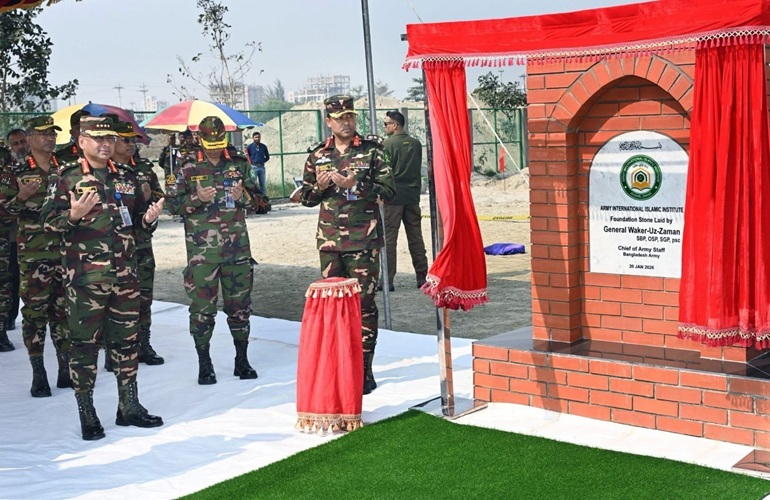
In a clear indication that the Bangladesh Army is now well on its way toward Islamisation of its rank and file, General Waker-uz-Zaman today laid the foundation stone for the Army International Islamic Institute (AIII) at the Jalsiri housing estate in Dhaka’s Purbachal area.
Gen Zaman read prayers, with raised arms, along with other senior officers from Army headquarters and Logistics Area at the site, in violation of several instituitionalised Army legal instruments and provisions, including the Manual of Bangladesh Military Law, Army Rules (Regulation) and the Army Rules (Instructions), whose violation is punishable.
While it is being made out that this is part of the Bangladesh Army’s efforts to “strengthening” the “national education system” with an emphasis on “integrating value-based education with modern academic curricula”, disquiet and anger prevails among the secular sections of the armed forces who see Gen Zaman’s move as the culmination of the Islamisation of the Army that began way back in the late-1970s.
The academic activities of the first AIII are set to commence this July at the Jolsiri campus. Additionally, the construction of another AIII building at Chittagong is currently underway.
There are plans to gradually expand this initiative to other formation areas of the Bangladesh Army.
Bangladesh defence sources said that building such religious institutions that will likely contribute to “further radicalisation” of the Army was in “complete violation” of the Manual of Bangladesh Military Law, Army Rules (Regulation) and the Army Rules (Instructions) even as three critical elements – politics, women and the overt practice of religion – are punishable offences, including termination from service after a court martial.

ALSO READ: Meghalaya CM inaugurates CIAT School, Integrated Police Welfare Complex at Baghmara
Historically, the Islamisation of the Bangladesh Army stemmed from Ziaur Rahman and H M Ershad who promoted Islam for legitimacy, alongside efforts by groups like Jamaat-e-Islami that has successfully infiltrated and radicalised the armed forces by various means, including establishment of coaching centres and ideological networks, aiming to shift the professional army towards an Islamist model.
This, Dhaka-based political and strategic analysts (who did not want to be quoted) said, would “not only seriously undermine the credibility and so-called professionalism of the Army but, if unchecked, may cause friction with defence forces of other countries”.