










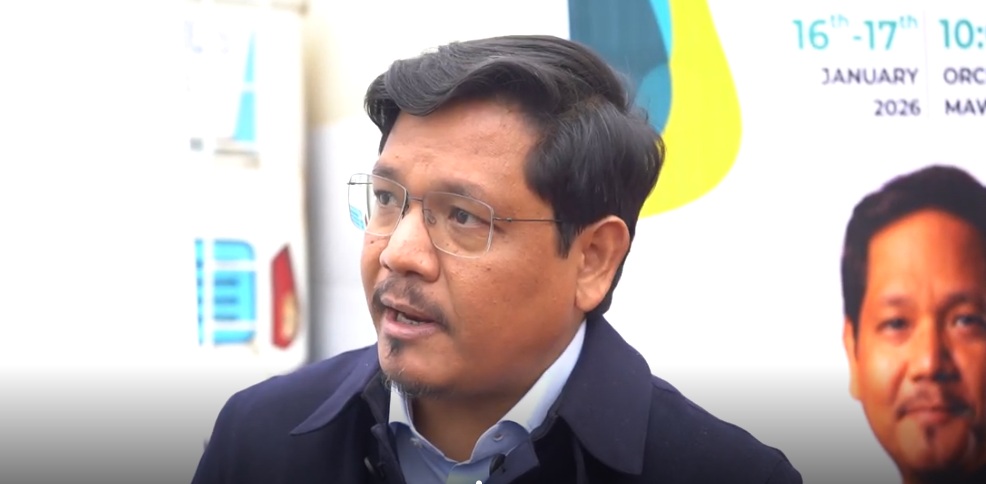
Shillong: The third Cabinet Retreat of the Meghalaya government concluded on Saturday at Orchid Resort in Mawkasiang, New Shillong, with a detailed roadmap aimed at unlocking the state’s economic potential under Vision 2032 and Mission 10.
The two-day retreat brought together Chief Minister Conrad K Sangma, cabinet ministers and senior officials to deliberate on key development priorities and the “10 Opportunities” identified to drive economic transformation.
While the first day focused on social commitments, discussions on Day 2 centred on growth-oriented sectors and long-term economic planning.
In his keynote address, Sangma outlined Meghalaya’s development trajectory and stressed the need to tap opportunities in tourism, agriculture and private sector investment.
Reiterating the government’s economic targets, he said the state aims to build a $10 billion economy by 2028, scale it up to $16 billion by 2032 and reach $100 billion by 2047.
He emphasised that achieving these goals would require coordinated and actionable planning across departments rather than aspirational targets alone.

Highlighting the importance of impact-driven governance, the chief minister said meaningful public service lies in improving individual lives on a daily basis, adding that small interventions often create the most lasting change.
Agriculture featured prominently in the deliberations, with a focus on institutional reforms, technology-driven solutions and policies to enhance farmer resilience and productivity.
The formulation of the Meghalaya Agriculture Policy 2026 was discussed as a comprehensive roadmap for sustainable growth, along with the promotion of agri-tourism to diversify rural incomes and showcase the state’s agricultural and natural heritage.
Sangma also underscored the need to leverage advanced technology to improve weather forecasting and reduce crop diseases.
The Animal Husbandry and Veterinary Department will prepare a contingency plan involving 171 rapid response teams to monitor livestock health, with the sector seen as key to boosting local production and reducing import dependence.
Discussions on sports revolved around the Sports Action Plan launched in 2025 and the 303 projects worth over Rs 2,000 crore currently underway for hosting the 2027 National Games.
The initiatives are aimed at creating a youth-focused sports economy and strengthening athletic infrastructure in the state.
On entrepreneurship, officials said more than 500 entrepreneurs have been incubated under PRIME Meghalaya, recording a 25 per cent increase in revenue after incubation.
The CM-ELEVATE programme is set to benefit over 3,800 entrepreneurs with an outlay exceeding Rs 130 crore.
Plans are also underway to finalise the state’s Startup Policy and launch a PRIME Venture Capital Fund to support high-growth enterprises through private investment.
The Tourism, Arts and Culture Department presented a roadmap to generate 1.25 lakh jobs by 2028.
A target has been set to develop 3,000 homestay units by 2028 under the CM Meghalaya Homestay Mission 2025, with a 70 per cent financial subsidy.
Sangma noted that changing tourist preferences, especially among younger travellers seeking curated experiences, make homestays a major growth opportunity.
ALSO READ: Singer B Praak receives death threat, Rs 10 crore extortion demand
Urban transformation strategies focused on decongesting Shillong through traffic restructuring and the organised relocation of hawkers, with similar models proposed for Tura and Jowai.
Grassroots innovations were also highlighted, including the transformation of anganwadi centres into integrated health and early learning hubs in East Garo Hills, and community-driven digital libraries in South Garo Hills’ Purakhasia block to address low literacy levels.
In his concluding address, Chief Secretary Shakil P Ahammed described the retreat as a milestone for inter-departmental collaboration and cross-learning, urging officials to adapt successful models locally with a “citizen-first” approach.
Closing the retreat, the chief minister said vision alone was insufficient without collective effort, and encouraged officers to take bold, actionable steps to translate plans into outcomes.