










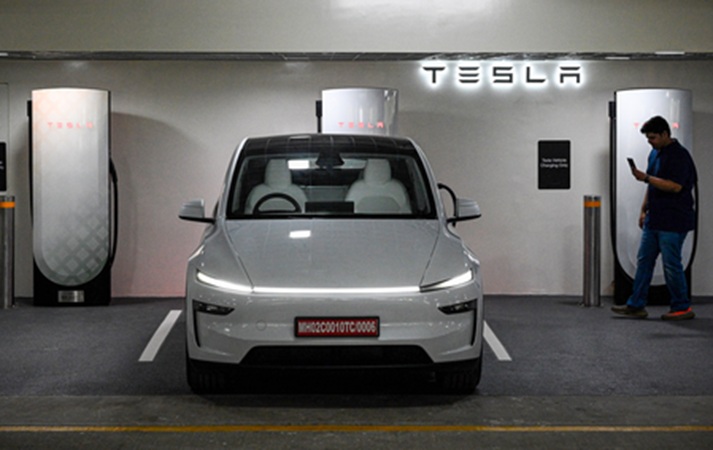
Tesla sold 225 units of its Model Y electric SUV in India during the calendar year 2025, according to industry data, marking its first partial year of retail operations in the country.
Data released by the Federation of Automobile Dealers Associations (FADA) showed that the US-based electric vehicle maker retailed 64 units in September, followed by 40 in October, 48 in November and 73 in December.
Tesla is yet to complete a full year of sales in India, having opened its first showroom in July.
The company currently sells only the Model Y in India, imported as a completely built unit and offered with a rear-wheel-drive powertrain.
The standard RWD variant is priced at Rs 59.89 lakh (ex-showroom), while the Long Range RWD version costs Rs 67.89 lakh (ex-showroom).
Prices remain significantly higher than in overseas markets due to India’s steep import duties on fully built vehicles.

Tesla operates experience centres in Gurugram, Mumbai and Delhi, supported by around 12 superchargers and 10 destination chargers across these cities.
The company claims a driving range of up to 500 km for the standard Model Y and up to 622 km for the Long Range version.
The standard variant accelerates from 0 to 100 kmph in 5.9 seconds, while the Long Range does it in 5.6 seconds, with both models having a top speed of 201 kmph.
ALSO READ: Meth tablets worth Rs 40 crore seized in Mizoram, five arrested
Tesla also claims that fast charging can add around 238 km of range for the standard model and about 267 km for the Long Range in 15 minutes.
Meanwhile, India’s electric vehicle market continued to expand in 2025, accounting for about 8 per cent of all new vehicle registrations, with total EV sales reaching 2.3 million units, according to data from the Vahan Portal.
A report by the India Energy Storage Alliance said electric two-wheelers led the growth, with sales of 1.28 million units, making up 57 per cent of total EV sales.
Electric three-wheelers accounted for 0.8 million units or 35 per cent, while electric four-wheeler sales stood at around 1.75 lakh units, driven largely by demand for small and light commercial electric goods carriers.