










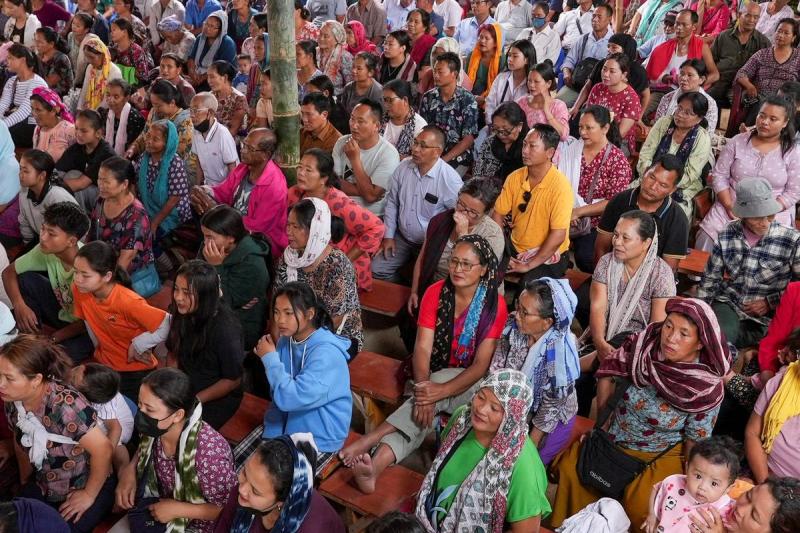
Imphal: The Manipur government on Wednesday said that the rehabilitation and resettlement of internally displaced persons (IDPs) continues to be its top humanitarian priority, with detailed security assessments underway at all proposed resettlement locations.
In a letter addressed to representatives of IDPs and the Coordinating Committee on Manipur Integrity, Special Secretary (Home) A Subash Singh stated that the resettlement process depends on multiple factors, including the prevailing security situation, site preparedness, land availability, fund allocation, climatic conditions and livelihood feasibility.
Manipur has witnessed prolonged ethnic clashes between the Meitei and Kuki communities since May 2023, in which at least 260 people have been killed and thousands displaced. The state has been under President’s Rule since February 2025.
“Rehabilitation and resettlement of IDPs remains the highest humanitarian priority. The process is being implemented in a phased, dynamic and pragmatic manner rather than as a rigid, one-time, deadline-driven exercise,” the letter stated.
The government informed that a comprehensive resettlement plan covering around 60,000 IDPs has been prepared under various schemes. It added that the rehabilitation strategy goes beyond mere physical relocation and focuses on education, livelihood support and the overall well-being of displaced persons.
According to the letter, phased resettlement has already been initiated under a Rs 523-crore Rehabilitation and Resettlement package announced in the Manipur Budget 2025–26.

Under the plan, Phase I involves resettlement of families whose houses were partially damaged, Phase II covers families provided housing under the PMAY-G (Special Package) within their respective districts, while Phase III focuses on inter-district relocation between valley and hill districts. This phase will require enhanced coordination, infrastructure development and strengthened security arrangements.
The government further said that joint planning is being undertaken by district commissioners, security forces and local stakeholders. Security barracks and deployment infrastructure are being integrated with housing development, and resettlement is being carried out only in areas where long-term safety and stability can be reasonably ensured.
The letter emphasised that IDP resettlement is being treated as a continuous humanitarian mission rather than a one-time administrative exercise, with regular interaction being maintained with community representatives to address grievances and restore dignity to those affected.