










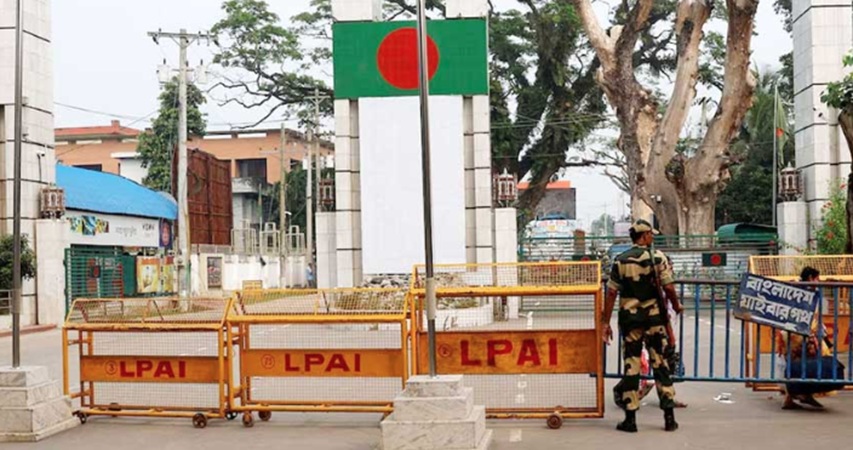
The Bangladesh Foreign Ministry’s decision to shut down its visa centre at the Kolkata, Chennai and Mumbai deputy high commissions was taken on December 29 but was deferred for implementation because of the December 30 passing away of BNP Chairperson Khaleda Zia, Northeast News has learnt.
The formal decision to suspend visa operations at Bangladesh’s three deputy missions was conveyed to the Indian authorities in Delhi on January 7 as part of a retaliatory measure following the Ministry of External Affairs’ move to stop issuing visas to Bangladeshi nationals at Chittagong, Rajshahi and Khulna deputy high commissions.
Among the principal reasons cited by the Bangladeshi authorities was lack of security in the wake of demonstrations by Indian political outfits following the targeting of India’s deputy high commissions in Chittagong and Khulna.
But Bangladeshi Foreign Ministry sources said that the unprecedented moves by both New Delhi and Dhaka is part of a definite downgrading in bilateral ties with the likelihood of further actions by both sides in the days to come.
The decision to suspend visa operations at the three Bangladeshi missions in India was decided when Bangladesh High Commissioner Riaz Hamidullah was called over at short notice to Dhaka on December 30.
What has worsened the situation is the “precipitative” action related to the Bangladesh Cricket Board’s strident call to shift all Twenty20 World Cup matches in which the Bangladesh cricket team was to play from venues in India to Sri Lanka.

The BCB acted after the Board of Control for Cricket in India (BCCI) recommended the non-inclusion of Bangladesh seamer Mustafizur Rahman in the Kolkata Knight Rider (KKR) team.
The Twenty20 World Cup matches are scheduled to be played in February and March 2026.
It is learnt that mainly three Bangladesh interim regime advisers – Asif Nazrul, Syeda Rezwana Hasan and Adilur Rahman Khan – were behind the BCB’s decision to call for shifting the Bangladesh cricket team’s match venues to countries other than India.
Nazrul, Hasan and Khan were among key Bangladeshis who had deep links with US State Department and security officials before August 2024.
They now maintain clandestine ties with not only US but also Pakistani officials.
In the backdrop of the rapid deterioration of India-Bangladesh bilateral ties, especially in the wake of domestic political and electoral conditions – elections in Bangladesh are scheduled to be held on February 12, 2026 – the departure of National Security Adviser (NSA) Khalilur Rahman to the United Arab Emirate and subsequently to the US assumes significance.
ALSO READ: NCB cracks Myanmar-linked drug network in Manipur, seizes heroin worth Rs 15 crore
Incidentally, Indian Army chief General Upendra Dwivedi also reached Dubai on January 7, but it is unlikely there will be a meeting between him and Khalilur Rahman.
Khalilur Rahman will likely meet American State Department and security agency officials during his US visit, ahead of newly appointed ambassador Brent Christensen’s arrival in Dhaka on January 12. Khalilur Rahman is scheduled to return to Dhaka the same day.
While the Mohammad Yunus-led interim regime awaits Christensen’s arrival – the Charge d’Affaires Tracey Ann Jacobson left Dhaka for good about a week ago – the Bangladeshi authorities are unlikely to take steps to normalise ties with India anytime soon.
But much will depend on Christensen’s approach towards the interim regime and whether his brief will be to push Dhaka to not heighten tensions before the February 12 polls.