










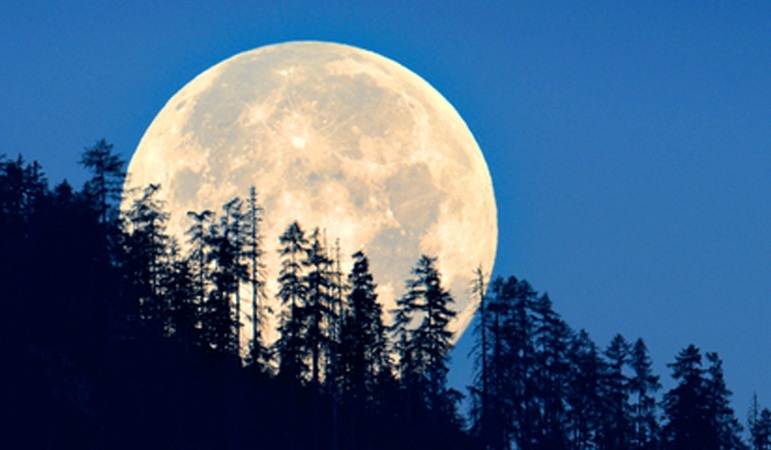
Paush Purnima, the first full moon of the Hindu lunar calendar in 2026, will be observed on Saturday, aligning with a rare celestial spectacle — the year’s first supermoon, popularly known as the ‘Wolf Supermoon’.
The Wolf Supermoon is expected to shine brighter and appear marginally larger than a regular full moon as it rises opposite the Sun in the constellation Gemini.
It will mark the first full moon of the year and the first of three supermoons forecast in 2026.
A supermoon occurs when the full moon coincides with perigee, the point in its elliptical orbit when it is closest to Earth.
As the Moon’s distance from Earth varies between about 356,000 km and 406,000 km, its apparent size and brightness change across the year.
On January 3, the Moon will be roughly 362,000 km away, making it appear around 6 to 14 per cent larger and 13 to 30 per cent brighter than when it is at apogee, or its farthest point.

January’s full moon is traditionally known as the Wolf Moon, a name rooted in Northern Hemisphere folklore linked to midwinter nights when wolves were believed to howl near human settlements.
While the term carries historical and cultural significance, it is now widely used to identify the first full moon of the year.
According to Time and Date, the Wolf Moon is expected to rise at around 3.32 pm IST on Saturday, with peak illumination occurring on January 3.
ALSO READ: 14 Maoists killed in separate encounters in Chhattisgarh’s Bastar region
Though the Moon may appear full for a few nights around this period, the moment of maximum illumination marks the official full moon.
Astronomically, a full moon occurs when the Moon is positioned directly opposite the Sun in Earth’s sky, allowing its entire visible surface to be illuminated. This alignment takes place roughly once every 27 days.
Paush Purnima holds deep religious and spiritual significance, with devotees observing rituals such as holy dips, fasting, prayers and charitable acts.
As per the Hindu Panchang, the Purnima Tithi began on the evening of January 2 and will end on the afternoon of January 3, making Saturday the main day of observance.
The Paush month is considered especially auspicious for spiritual practices during the winter season.