










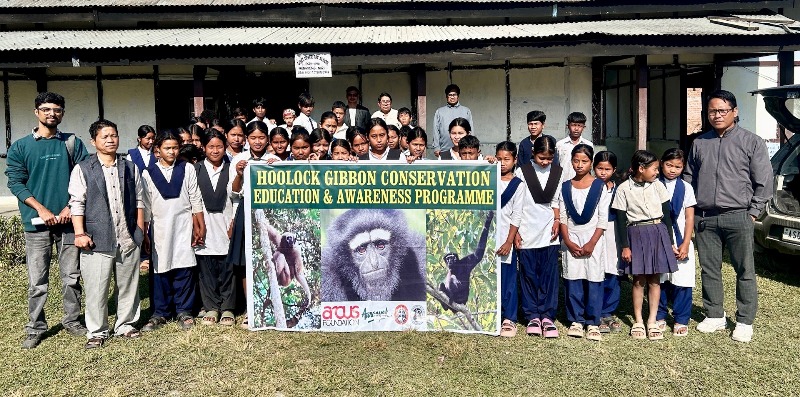
Namsai: Northeast’s leading biodiversity conservation organisation, Aaranyak, in collaboration with the Namsai Forest Division and with support from the Arcus Foundation, has been conducting conservation education and awareness programmes on the Hoolock gibbon in Arunachal Pradesh’s Namsai district since November 12, 2025.
This first-of-its-kind initiative in Namsai district began at Government Upper Primary School (GUPS), Deobil, on November 12, 2025, and was inaugurated by the school’s head teacher, N. W. Namchoom.
The programme has so far covered 18 schools, ranging from upper primary to higher secondary levels, across Namsai district. A total of 1,092 students, 80 teachers, and members of the local community have benefited from the initiative.
Akshay Kumar Upadhyaya, researcher of the Primate Research and Conservation Division of Aaranyak, acted as a resource person during the programmes.
The programmes primarily focused on students living along the fringes of the reserve forest, with the aim of nurturing a group of motivated young participants who can contribute to future gibbon conservation efforts. The sessions included pre- and post-assessments, using carefully designed questionnaires to assess students’ knowledge levels before and after the intervention.
Interactive learning methods, including audio-visual aids, PowerPoint presentations, live discussions and illustrations, were used to explain the ecological importance of primates, the role of hoolock gibbons in forest ecosystems, and the broader significance of biodiversity conservation.

Pre-assessment findings indicated a limited baseline understanding among students, with correct responses ranging from 11% to 29%. However, post-assessment results showed a marked improvement following the awareness sessions, with scores rising to between 60% and 90% and reflecting an average knowledge gain of over 50–60%. The findings underscore the effectiveness of the programme in significantly enhancing students’ understanding and engagement.
The initiative highlights the importance of structured, interactive educational interventions in strengthening environmental awareness and improving learning outcomes. By equipping students with knowledge and fostering a sense of responsibility towards nature, Aaranyak’s programme has delivered measurable and meaningful impact across participating schools, reaffirming the crucial role of education in long-term wildlife conservation.
Dr. Dilip Chetry, senior primatologist, Director & Head in the Primate Research and Conservation Division of Aaranyak, who also serves as the Vice Chair of the IUCN Primate Specialist Group, South Asia Section, emphasised that the Western Hoolock gibbon is the only ape species found in India and is genetically very close to humans.
ALSO READ: Arunachal Pradesh to re-verify land claims for Frontier Highway after scam allegations
He noted that this endangered, arboreal, frugivorous primate, found in the seven northeastern states of India, is restricted to areas south of the Brahmaputra and east of the Dibang river system.
The Namsai Forest Division, which comprises seven Reserve Forests, three Anchal Reserve Forests and three Village Reserve Forests, forms a crucial habitat for gibbons.