










By Shiamak Ali
Following the victory of Awami League in the 2008 general elections, Tarique Rahman, a leader of the Bangladesh Nationalist Party (BNP) and son of former Prime Minister Khaleda Zia, went into forced exile in London citing security concerns and politically-motivated persecution by the ruling party.
But what was initially framed as a temporary retreat would stretch into a sixteen-year absence from the country’s political arena.
During this period of absence, consolidation of power in the hands of Prime Minister Sheiklh Hasina, was done through a slow and deliberate process by systematically incapacitating the BNP by engaging in leadership decapitation through lawfare, weaponisation of the criminal justice system and electoral engineering sustained by political patronage.
Institutions were not dismantled outright; they were aligned, incentivized, and rendered predictable. Institutional loyalty was traded in for protection and advancement.
Rahman’s long exile coincided with the hollowing out of his party. Leading the BNP from London meant operating through intermediaries, encrypted calls and a shrinking circle of trusted figures. The constraints brought on by distance were discernible — diluted authority, slower decision-making.

Strategic decisions were often reactive rather than proactive, shaped by events rather than anticipation. The BNP, however, did not collapse entirely — and that endurance owes less to the charisma of the remote leadership than to the party’s institutional stubbornness.
The survival of the BNP during these turbulent years is largely due to the noteworthy contributions of figures such as Mirza Fakhrul Islam Alamgir, Ruhul Kabir Rizvi, Amir Khasru Mahmud Chowdhury, and other senior leaders. Carrying the organizational burden during these years, their role was less about renewal and more about preservation — keeping the party intact, maintaining networks, absorbing repression, and ensuring that the BNP remained a recognizable political vehicle rather than a footnote in history.
Self-inflicted Paralysis
The imprisonment of Rahman’s mother and former Prime Minister, Khaleda Zia, marked a turning point — not just politically, but personally. Politically, the incarceration of the matriarch and the long-standing pillar of unity within the BNP hardened the sense that the party was being systematically neutralized. But personally, it underscored Rahman’s isolation. Rahman’s inability to return to Bangladesh or visit her during this period became a recurring symbol for supporters: not of resistance, but of political paralysis.
A party led by figures who were absent, incarcerated, or legally neutralized could not credibly project itself as an alternative government.
However, none of this absolved the BNP of its own failures. Over time, the party substituted strategy with grievance and reorganization with nostalgia. Fifteen years is a long time to be out of the political limelight, where relevance is currency and political memory is neither sentimental nor forgiving.
The BNP failed to meaningfully engage a generation that had no lived memory of BNP governance, and the consequence was stagnation.
July 2024 Uprising
The political rupture came not from BNP mobilization, but from outside the traditional party framework. The July Uprising of 2024 was driven less by allegiance to any single political party and more by a desire for meaningful change — a rejection of entrenched systems that, after 15 years of Awami League rule, had come to feel immovable and extractive. Public and private institutions alike bore the marks of over-centralization, politicization and decay.
But revolutions that lack structure tend to create vacuums rather than solutions. The interim government led by Dr. Muhammad Yunus inherited a fractured, and a highly polarized society with the still-relevant political parties vying for the coveted crown. The interim government was successful in stabilizing the economy in the months succeeding the mass uprising, but in the absence of authority, old fault lines emerged and political rivalry led into social hostility.
Dr. Yunus’ government was marketed to the public as a moral reset — a technocratic pause that would cleanse the system of political rot. It was a one-in-a-lifetime opportunity to break the vicious cycle of corruption and identity politics that Bangladeshis have had to endure since the country’s inception. It beckoned the emergence of a new generation of Bangladeshis led by ordinary students — a divergence from the long-standing toxic mindset entrenched in the existing political and cultural apparatus, where self-interest and dogmatism had prevailed over the betterment of the state.
Ills Continue
What followed was nothing short of a fall from public grace. Many of the student leaders who emerged as moral protagonists of the uprising soon displayed the same reflexes that had defined the order they opposed. Allegations of corruption, nepotism, bigotry, and extortion surfaced with uncomfortable speed. What was framed as a clean break began to resemble continuity in different clothes — a stark reminder that removing a regime does not automatically remove its habits.
More damaging still was the administration’s tolerance of disorder. Mob violence, vigilantism, and extra-legal enforcement were allowed to fester under the guise of “transitional instability’’, as if the collapse of basic law-and-order were an acceptable cost of moral posturing.
Corruption allegations involving advisers and affiliates were not confronted with transparency but brushed aside with silence, procedural delay, or selective outrage. Accountability appeared conditional — aggressive where it was convenient, absent where it was uncomfortable. Moreover, any fingers pointed towards Yunus were deemed morally untenable and the fault was said to lie with those around him rather than the Chief Adviser himself — identical to an old-tune people sought to cover their ears from.
Fractured Sainthood
Yunus did not merely fail to restore institutional authority — he presided over its further erosion. The turning point in the sainthood narrative of the Chief Adviser of the Government of Bangladesh was the assassination of the spokesperson of Inqilab Mancha, Sharif Osman bin Hadi. He was a pivotal figure of the revolution and the masses deemed it to be a massive oversight by the government. What followed was a series of mob violence incidents, packaged as retribution, targeting prominent news agencies such as “The Daily Star” and “Prothom Alo”; the lynching of a Hindu factory worker based on loose allegations of religious intolerance; and attacks on cultural establishments
Tarique Mythologised Return
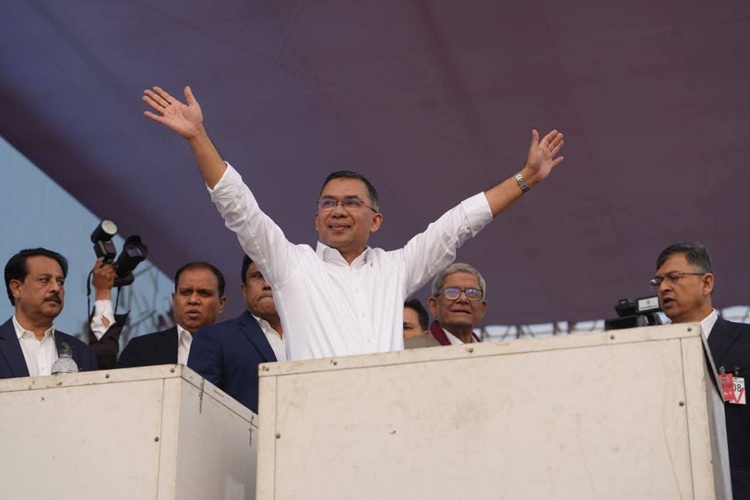
This context matters as a precursor to the long-anticipated return and public address of Tarique Rahman on 25 December 2025. By the time Rahman finally set foot back in Bangladesh, his return had already been mythologised.
It had been discussed, speculated over, and strategically delayed since the fall of the Hasina regime. It marinated for well over a year as the country drifted through a difficult post-uprising limbo.
This was not merely the homecoming of a political figure. It was framed as a signal: that general elections were inevitable, that the chaos of a power vacuum was nearing its end, that some form of political normalcy might finally reassert itself.
In a period marked by uncertainty, fragmentation, and institutional fatigue, Rahman’s return was loaded with expectations he did not personally create — but would nonetheless have to confront.
Bangladeshis at home and abroad tuned in, not out of uniform loyalty, but out of anticipation. Supporters looked for reassurance. Sceptics looked for substance. Many simply wanted clarity — a sense of direction after months of drift. This was meant to be a defining moment, not because of who Rahman was, but because of what the moment demanded: leadership that could move beyond symbolism and speak credibly to a country exhausted by both authoritarian consolidation and revolutionary chaos.
Anti-Climactic Speech
As someone with no interest in partisan loyalty but with every interest in competent leadership, I found the speech itself anti-climactic.
The moment demanded an absolute air of certainty — not bravado, not vengeance, but authority exercised justly and without hesitation.
Bangladesh is not short on anger or slogans — it is short on confidence in its institutions and faith in those who seek to lead them. After seventeen years in exile, this was an opportunity to speak not only to party loyalists, but to a fractured nation in need of cohesion. One expected a speech shaped by time, sharpened by distance, and conscious of the historical weight it carried and the vacuum it was stepping into.
Instead, the speech leaned heavily on symbolism. Tarique Rahman anchored his address around a rhetorical inversion of Martin Luther King Jr.’s famous speech — “I have a dream” — offering instead, “I have a plan.” The intention was evident: pragmatism over poetry, execution over idealism. Yet the invocation invited an unavoidable comparison. King’s words endured not because they inspired hope, but because they articulated moral clarity at a moment of deep uncertainty. Rahman’s plan, by contrast, remained abstract – a statement of intent without the force of certainty behind it. In a country no longer short on promises, that distinction held the utmost importance.
He had sixteen years to prepare for this moment. Sixteen years to craft a speech not just for his party, but for a country fractured along political, social, and moral lines.
It would have been entirely within his framework to clamp down — clearly and unequivocally — on corruption, extortion, mob violence, and the quiet normalisation of impunity that now cuts across every faction. To say, plainly, that accountability would not wear party colours.
That victims would have his support regardless of affiliation. That wrongdoing would be addressed based on conduct, not convenience.
Social Principles
This was also a moment to speak about social principles — to draw a line against collective punishment, vigilantism, and the idea that political grievance justifies harm.
To remind people that restraint is not weakness, and that one does not destroy one’s neighbour in the name of justice, regardless of creed or cause. None of this required political theatre. It required conviction.
The speech, however, played it safe. It gestured toward unity but avoided naming what has fractured it. It spoke of calm without confronting the forces that have made disorder routine. Even the sacrifices of those within his own party — figures who endured arrests, harassment, and political erasure on the ground during those long years of absence — went largely unacknowledged.
Bangladesh does not need fury for its own sake. But it does need resolve. A strong-willed leader — not merely in tone, but in action.
A leader capable of delivering a return address that stirs emotion without fanning division, that channels anger without weaponizing it.
Any animosity Rahman carries after years of exile is understandable. But that anger should be directed at the system — the machinery that forced exile, and was marked by selective justice, and institutional decay — not recycled into political retribution.
Absence of Substance
This was a moment to declare that no citizen should ever again be subjected to the same fate in an unjustified manner. The fanfare was inevitable. The substance, on this occasion, felt deferred.
It is also worth acknowledging that exile extracts a quieter toll. Sixteen years away from the country — its streets, its rhythms, its daily anxieties — can thin even the strongest political instincts. In that sense, the gap between expectation and delivery may reflect not indifference, rather distance.
The speech suggested a leader still recalibrating his connection with the people he seeks to lead. This, then, may be less an indictment than a moment of transition — a case of fanfare outpacing reality, not irreversibly, but temporarily.
Tarique Rahman now stands at the threshold of responsibility rather than anticipation. If he is to meet the moment, he may have to grow into his crown — not through symbolism alone, but by re-earning proximity, trust, and authority through action. The opportunity remains. Whether it is seized will define not just his leadership, but the country’s path forward.
(Based in Australia, the writer works for a Chinese think tank)