










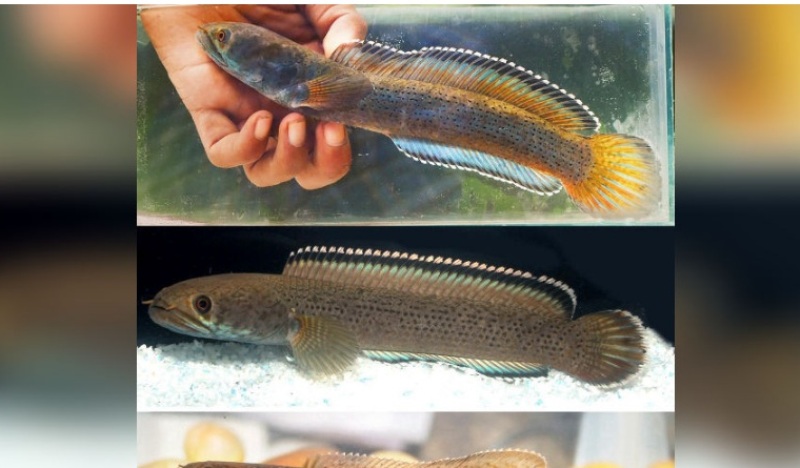
Shillong: A small hill stream flowing past a village in Ri-Bhoi district has brought fresh recognition to Meghalaya’s natural wealth. Scientists have identified a new species of snakehead fish, Channa bhoi, highlighting the state’s importance as a hub of freshwater biodiversity.
The study, authored by Jayasimhan Praveenraj, Nallathambi Moulitharan, Aristone M. Ryndongsngi, Tejas Thackeray, Ravi Shanthy Naveen and Annam Pavan Kumar, has been published in the international journal Ichthyology & Herpetology.
Lead author J. Praveenraj said the fish first came to his notice in 2019 after it was pointed out by Aristone M. Ryndongsngi, a resident of Ri-Bhoi district and a co-author of the paper.
“This fish was first brought to my notice by Aristone in 2019—the same person who discovered Channa aristonei,” Praveenraj said. “What intrigued us was that it was found just behind his home in Ri-Bhoi district.”
Initially, the species appeared to be extremely rare. “We were unable to obtain additional specimens at first,” Praveenraj said. He added that it was only in 2020, after more samples were collected, that they could confirm it was a species new to science.
The fish inhabits a small, shallow mountain stream marked by boulders and riparian vegetation—an environment typical of Ri-Bhoi’s upland terrain but one that remains inadequately explored. Detailed analyses of its colour patterns and genetic characteristics revealed that Channa bhoi is distinct from all other known snakehead species, including those previously recorded from Meghalaya.

“Since the species is endemic to Ri-Bhoi, I felt it was an honour to name it after the Bhoi community, the original inhabitants of the region,” Praveenraj said.
Scientists point out that Meghalaya, particularly the Khasi and Ri-Bhoi hills, has emerged as a major centre of snakehead fish diversity, with several new species described in recent years. The discovery of Channa bhoi once again shows that the state’s streams—often flowing quietly past homes and villages—can still harbour species unknown to science.
ALSO READ: Meghalaya MP urges Centre to protect Barapani botanical garden from NH-6 acquisition
The finding underscores the urgency of protecting small hill streams from pollution and unregulated development, as species with such limited distributions could disappear before they are even documented.